
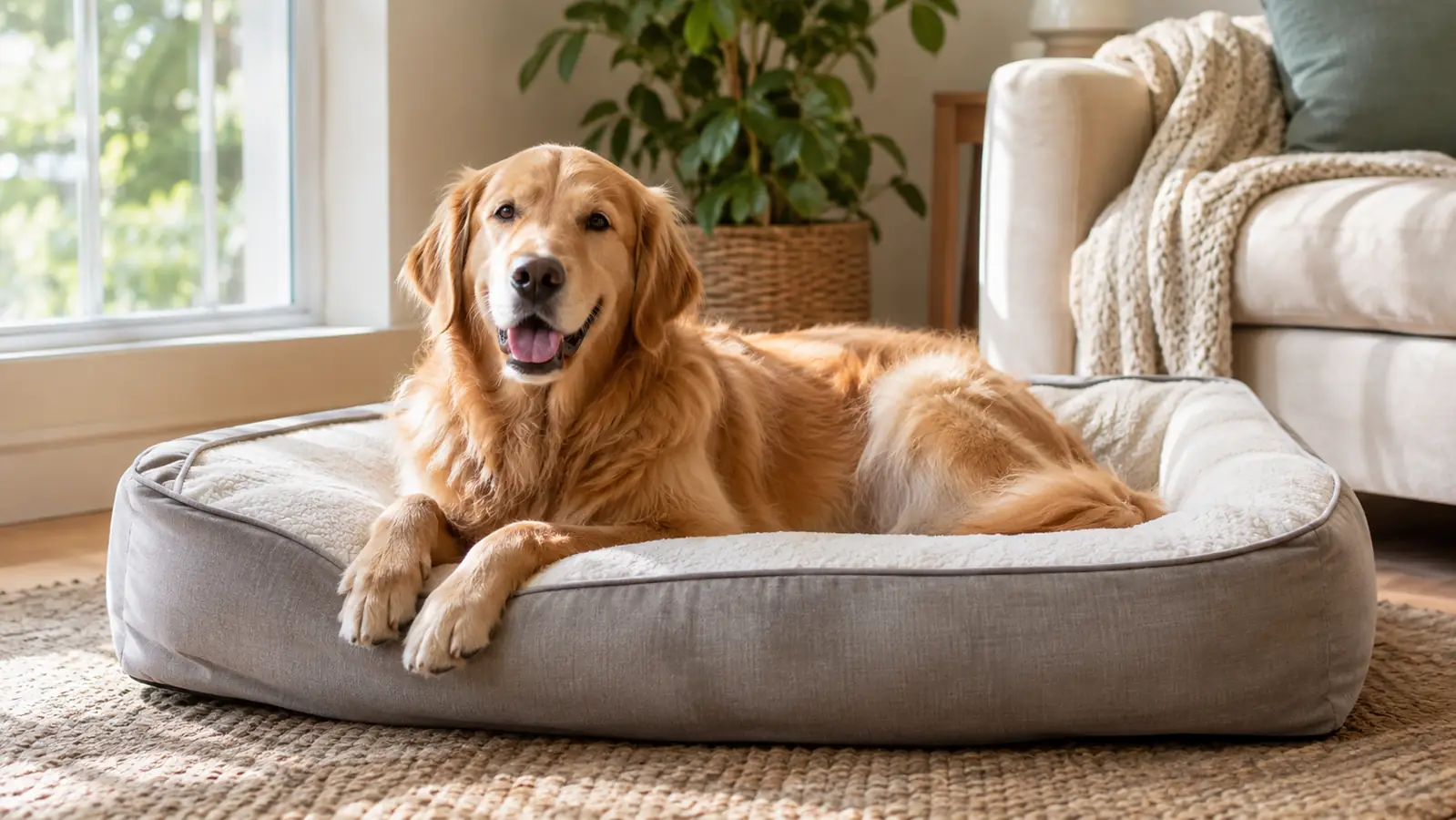
Murphy started getting up slow last fall. He is a 10-year-old yellow Lab mix, about 72 pounds, and for a while I told myself it was just the cold. Then I watched him circle his old bed three times, lower himself down like the floor was made of glass, and let out a sigh that broke my heart. My vet said his hips were stiff, not broken, and that a good orthopedic bed was worth trying before we talked about anything stronger. So I read labels for two weeks, ordered the EHEYCIGA Orthopedic Dog Bed, and started keeping notes the way I used to keep attendance records. I measured the old bed, I timed how long he took to get up, and I wrote down what I saw every morning for the first month.
This is not a vet's opinion and it is not a lab test. It is one dog owner's months-long record of what changed, what did not, and what I would tell a friend who is standing in the same aisle I was standing in. If you are here because your dog is slowing down, start with your vet. Then come back and read the rest.
The Quick Verdict
The EHEYCIGA orthopedic bed is the rare product that does what the package promises: real support for a stiff older dog, a cover that survives washing, and a base that has not flattened after months of nightly use.
Amazon Check Today's Price →A bed that still holds its shape after months of a 72-pound dog
If your dog is slowing down the way Murphy was, the EHEYCIGA orthopedic bed is the one I kept in the living room. Check today's price on Amazon and see if it fits your dog's size.
Amazon Check Today's Price on Amazon →How I've Used It
I ordered the large size in early November. Murphy was 72 pounds at his last weigh-in, and the bed gives him room to stretch out without hanging off the edge. It sits in the corner of our living room, on a hardwood floor, and it has not slid more than an inch since the day I put it down. The non-slip bottom is not a gimmick; it is the reason I stopped tripping over a bed that had migrated to the middle of the room by noon. I picked the large because the measurements on the listing matched the space next to the couch, and I am glad I did not size down.
Murphy sleeps on it every night, and he naps on it every afternoon. That is roughly nine hours a night plus two or three hours in the middle of the day, every single day for months. I washed the removable cover every other week for the first two months, then every week once I realized how much fur and dust it was catching. The cover has been through the wash more than a dozen times and it still zips back on without a fight. The first wash was the test I cared about; a cover that shrinks or pills after one cycle is useless to me. This one came out the same size and same shape.
The waterproof liner is the detail I did not expect to care about. Murphy has had two accidents since we brought the bed home, both after he drank too much water too fast. The first one happened on a Tuesday night in December. The liner caught both of them. The foam underneath stayed dry, and I did not have to throw the whole bed in the trash like I did with his old one. I wiped the liner down with a damp cloth, let it air out, and the bed was back in use the next morning.
The first night, Murphy walked over, sniffed the whole bed, and stepped onto it like it might bite him. He circled twice, lay down, and was asleep within five minutes. I stood there watching him, half waiting for him to climb off and go back to his old spot. He never did.
What the Memory Foam Actually Does for a Stiff Dog
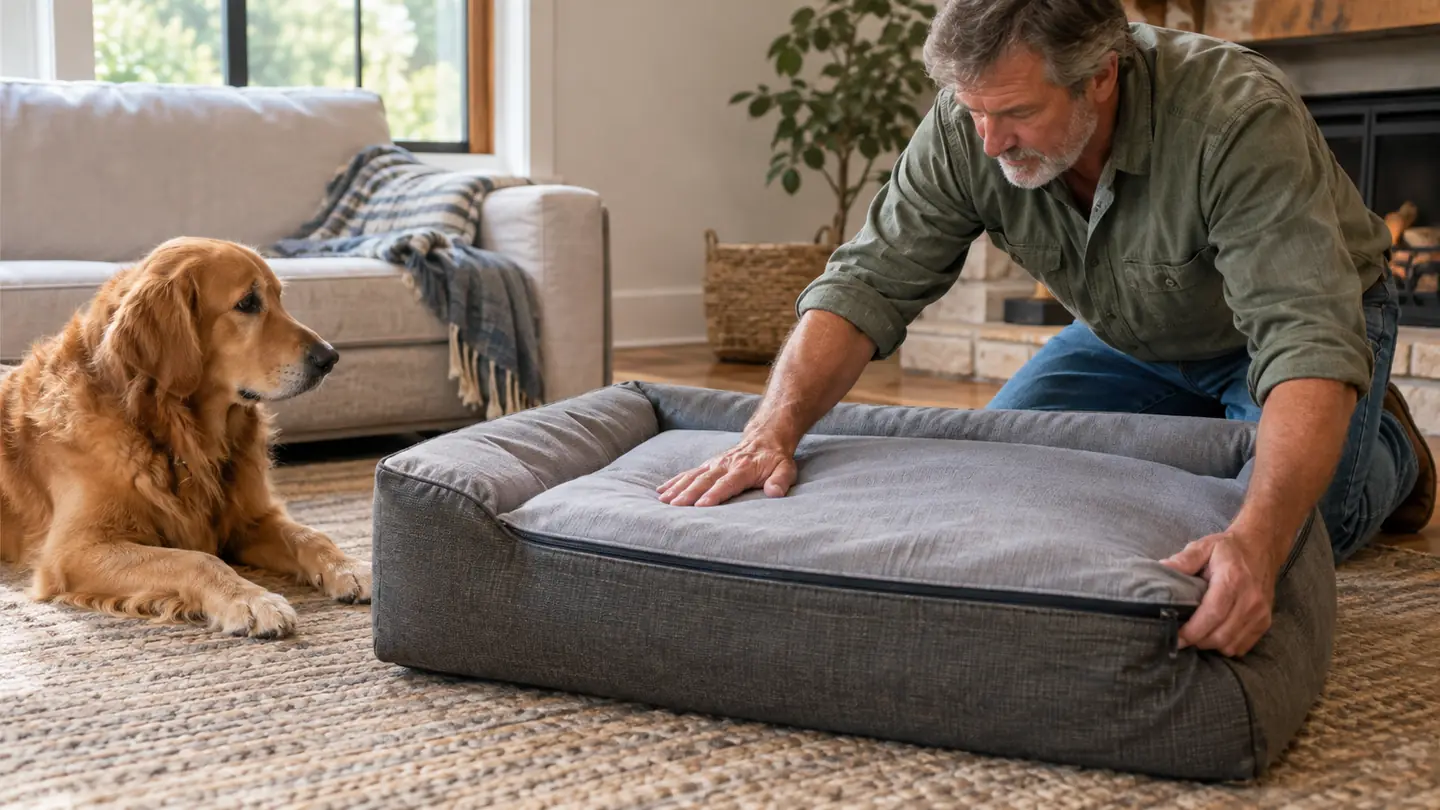
The EHEYCIGA bed uses a thick memory foam base with a layer of support foam under it. I am not a materials engineer, so I will tell you what I observed instead. When Murphy lies down on it, he does not sink to the floor. His hip stays level with his shoulder, and when he gets up, he does not have to rock back and forth to find his footing. That was the single biggest change I noticed in the first week. By day three I saw him flop down instead of easing himself down, and that is when I started to believe the foam was doing something.
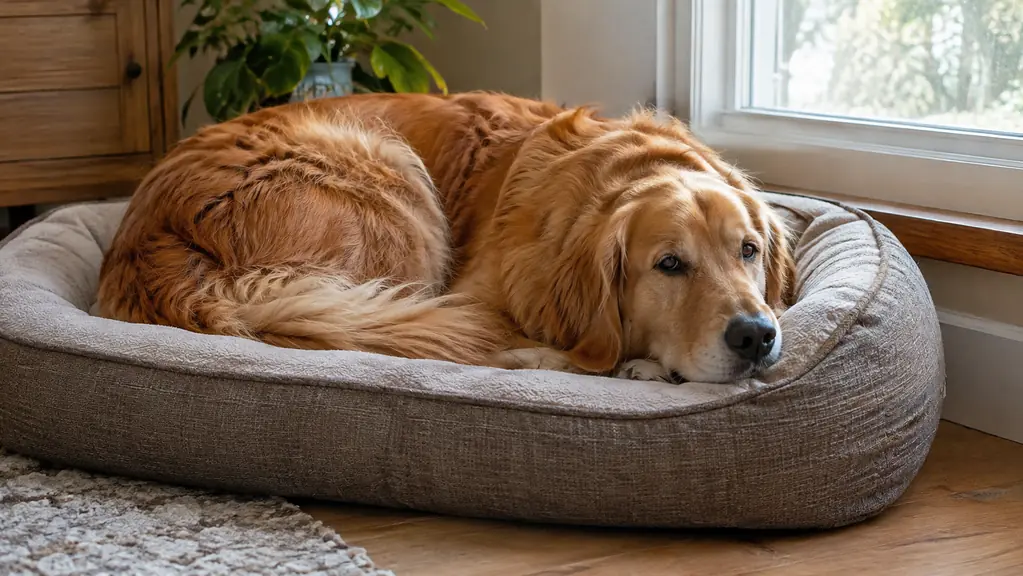
The raised sides are not just for cuddling. Murphy rests his head on the edge like it is a pillow, and when he curls up, the sides keep him from rolling off. For a dog his size, that matters. He used to slide off his old flat bed in the middle of the night and wake up on the hardwood. That has not happened once with the EHEYCIGA. He also uses the side as a chin rest in the afternoon, which keeps his head off the cooler floor draft near the window.
I will be honest about the limits. Memory foam is not a cure for arthritis, and it will not undo years of wear on a dog's hips. What it does is remove one source of pain: the hard, cold floor. Murphy still gets up slowly some mornings, but he gets up more easily than he did before, and he settles into the bed faster at night. That is the outcome I was hoping for. It did not fix his stiffness overnight, and I did not expect it to.
One detail I noticed is how quickly he falls asleep. In November he would circle the bed for a minute before lying down. By February he was walking over, turning around once, and dropping his head onto the side. I think that is because the surface does not fight him. A dog who is comfortable does not need to rearrange the whole bed to find a soft spot.
How It Held Up Over Months of Daily Use
The test I care about most is whether the foam flattens. I have owned dog beds that were pillows in a costume, and by month two they were as flat as a folded towel. The EHEYCIGA base has kept its shape. I press my hand into it every few weeks, and it springs back the same way it did in November. For a 72-pound dog who sleeps in the same spot every night, that is the difference between a bed that lasts and a bed that becomes a pancake. I checked it again at the start of February, and the indent where Murphy lies is barely visible once the cover is back on.
The cover has held up too. No rips, no loose seams, no zipper that jammed. The fabric is soft but not delicate, and it has survived Murphy's nails, his fur, and the occasional muddy paw. I have washed it in cold water and dried it on low, and it comes out looking almost new. The one thing I would change is the color options, but that is a style complaint, not a quality one. I also wish the cover had a handle, because carrying a large bed to the laundry room is awkward, but that is a small thing.
The non-slip bottom is still doing its job. I checked the underside after a few months and the grip pattern has not worn down. The bed stays where I put it, which means Murphy's water bowl stays where I put it, which means I am not mopping up a tipped bowl every morning. On our hardwood floor, the bed does not slide even when Murphy jumps off it in a hurry, and he does jump off it in a hurry when the doorbell rings.
I should also mention the stitching around the zipper. That is the first place cheap beds fail, because the zipper sits under tension every time the cover goes on and off. After months of washing, the stitching around Murphy's bed is still intact. I checked every seam at the end of January and found nothing loose.
The Cover, the Liner, and the Parts That Make Life Easier
The removable cover is the feature I use more than any other. It zips off in under a minute, goes in the wash, and goes back on without a wrestling match. I have owned beds with 'removable' covers that required a degree in origami to reassemble. This one is genuinely easy, and that matters when you are washing it every week. I unzip the top, pull it off the foam, and turn it inside out before I put it in the machine. That keeps the fur from sticking to the inside of the drum.
The waterproof liner sits between the cover and the foam. It is the reason I did not have to replace the bed after Murphy's accidents. If you have an older dog, a dog with a bladder issue, or a dog who drinks like a fish, this liner is the difference between a ruined bed and a bed that lasts for years. I tested it once by pouring a cup of water on the liner after I had the cover off, and the water beaded up and rolled off. I did not expect to do that test, but now I am glad I did.
The raised sides are firm enough to support Murphy's head but soft enough that he does not avoid them. He uses them as a pillow more often than he uses the flat center. For a dog who likes to curl up, that extra support around the edges is a real feature, not a marketing bullet point. When he stretches out, his head hangs off the side onto the floor, but he chooses to do that on warm days, so I do not worry about it.
One more thing about the liner: it does not crinkle. I was worried a waterproof layer would sound like a rain jacket every time Murphy shifted. It does not. The bed is quiet, which matters in a small house where every sound carries.
What I Liked
- Foam base keeps its shape after months of nightly use by a 72-pound dog
- Cover zips off and washes without shrinking or losing its fit
- Waterproof liner protects the foam from accidents
- Non-slip bottom stays put on hardwood floors
Where It Falls Short
- Not for determined chewers; the cover is durable but not indestructible
- Large size is heavy to carry when the cover is off
- Color options are limited
The foam still springs back the same way it did in November. For a 72-pound dog who sleeps in the same spot every night, that is the difference between a bed that lasts and a bed that becomes a pancake.
Who This Is For
This bed is for the owner of a dog who is getting older and stiffer, the way Murphy is. If your dog hesitates at the back porch steps, gets up slowly after naps, or has started avoiding the floor in favor of the couch, an orthopedic bed is one of the few things that can help without a prescription. It is also for owners who are tired of washing a bed that cannot be washed, or replacing a bed that flattens after two months. If your dog is between sizes, I would size up. Murphy has room to stretch, and a bed that is too small is not going to give the support.
It is for people like me who want to do something concrete for a dog who cannot tell us where it hurts. I cannot fix Murphy's hips, but I can give him a place to sleep that does not make them worse. That is a small thing, and it is also not a small thing. Every morning when I see him get up without the hesitation he had in October, I am glad I made the change.
Who Should Skip It
Skip this bed if your dog is a chewer. The cover is durable, but it is not indestructible, and a determined chewer will find the zipper. Skip it if your dog is still young and healthy and sleeps anywhere without complaint; a basic bed will do the same job for less. And skip it if you are expecting a cure. This is a bed, not a treatment. If your dog is in real pain, talk to your vet before you spend money on anything.
I also would not buy this bed for a dog who prefers to sleep on the floor no matter what. Some dogs just do. Murphy took to it immediately, but I have known dogs who would rather lie on cold tile than on the softest memory foam. If that is your dog, save your money. And if you are buying this as a gift for someone else's dog, ask about the dog's habits first, because a bed is only useful if the dog will actually use it.
The bed I would buy again for Murphy
After months of nightly use, the EHEYCIGA orthopedic bed is the one I would order again tomorrow. Check today's price on Amazon and see if it is the right size for your dog.
Amazon Check Today's Price on Amazon →