

Murphy is 10 years old, a yellow Lab mix, about 72 pounds. Last spring I noticed him hesitate at the three back porch steps, then get up slowly after naps. Our vet said his hips were stiff and suggested I think about omega-3s. I spent a couple of weeks reading labels and asking around, and I kept coming back to Nordic Naturals Omega-3 Pet. This is what I learned after giving it to him every day for more than six months.
I am not a vet, and I am not going to tell you this will fix anything. What I can tell you is what I saw in my own dog, how I gave it to him, and what I wish someone had explained to me before I started.
The Quick Verdict
A clean, third-party-tested fish oil that made a real difference in how easily Murphy gets up and down. It costs more than the bargain bottles, and the pump takes getting used to, but I plan to keep buying it.
Amazon Check Today's Price →A fish oil that earned its spot in our morning routine
After months of daily use, Nordic Naturals Omega-3 Pet is the supplement I reach for first for Murphy's stiff hips. See today's price on Amazon and decide if it fits your dog's routine.
Amazon Check Today's Price on Amazon →How I've Used It
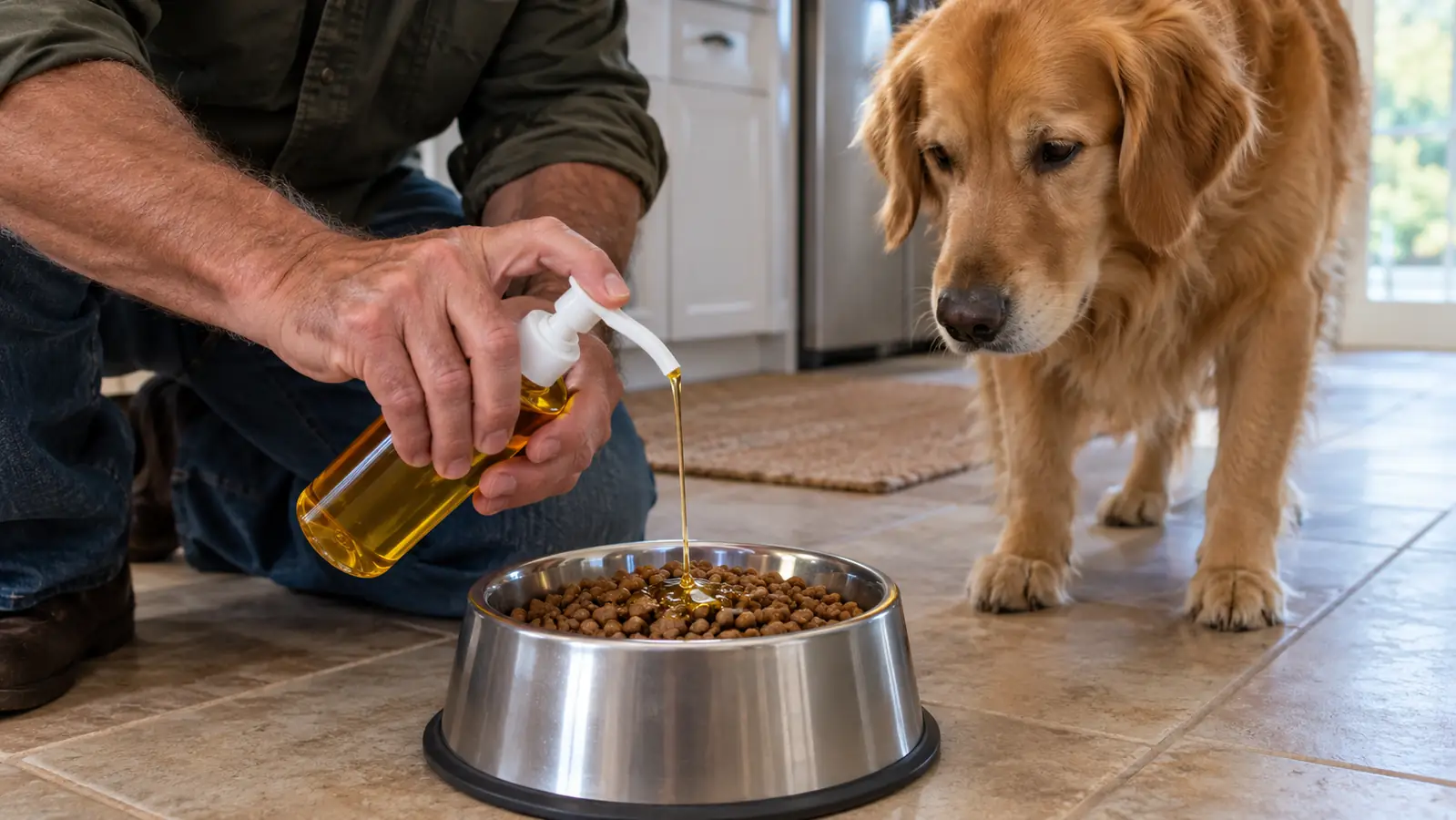
Nordic Naturals Omega-3 Pet comes in an 8-ounce bottle with a pump. The serving for a dog Murphy's size is about 4 pumps a day, which works out to roughly 1,380 mg of fish oil with EPA and DHA. I eased into the full amount over a few days, and after that I gave it to him with dinner every single evening.
The oil is a light golden color and has a mild fish smell, not the strong one you get from some bottles. I pumped it right over his kibble and stirred it in. Murphy has never once turned his nose up at it, which surprised me, because he is picky about medicine. The pump is the one part I had to learn: you have to hold the bottle upright and pump slowly, or it spits. After the first week it became routine.
I kept a simple note in my phone. Every couple of weeks I wrote down how he did on the porch steps, how long it took him to get up from his bed, and whether he wanted to walk the full loop or turn for home early. That note is where everything I am about to tell you comes from.
I tried a few different ways to give it to him. At first I mixed it into a spoonful of plain yogurt, which worked but added extra calories. Then I tried squirting it directly into his mouth, which he tolerated but did not like. The easiest method turned out to be pouring it over kibble while it was still dry, then adding a little warm water and stirring. That way the oil coated the pieces evenly and Murphy licked the bowl clean.
Do not be afraid to start slowly. For the first four days I gave Murphy two pumps instead of four, just to see how his stomach handled it. He never had any loose stools, so I moved up to the full four-pump serving on the fifth day. If your dog has a sensitive stomach, that ramp-up is worth doing.
What the Label Actually Says
The front of the bottle says 1,380 mg fish oil for dogs with EPA and DHA. Flip it over and the guaranteed analysis lists 400 mg of EPA and 300 mg of DHA per serving. Those are the two omega-3 fatty acids that matter most for joint health, and the amounts are right in line with what our vet suggested for a dog Murphy's size.
Nordic Naturals is one of the few brands I found that publishes third-party testing results for every batch. They use Friend of the Sea certified fish, and the oil is molecularly distilled to remove heavy metals and PCBs. I am not the kind of person who takes a company's word for that, so I looked up their testing reports online before I bought the first bottle. They are easy to find, and that is a big part of why I trusted this brand over a cheaper option.
One thing the label does not tell you is that the bottle should be refrigerated after opening. I keep ours in the fridge door and take it out a few minutes before dinner so the oil pours easily. Cold oil is thicker, and the pump works better when the bottle has warmed up a little.
The lot number is printed on the side of the bottle. On the Nordic Naturals website you can enter that lot number and pull up the certificate of analysis for your exact bottle. I did this with the first bottle I bought: the report listed mercury, lead, cadmium, and PCBs, all well under the limits. Knowing I could check that from my kitchen counter made the higher price easier to swallow.
The ingredient list is short enough that I could read the whole thing without a magnifying glass. That is not true of every joint supplement I have looked at.
What Changed for Murphy, and When
I want to be honest about the timeline, because nobody should expect a quick fix in a week. For the first two or three weeks I did not see much of anything. Murphy was the same dog, same slow start in the morning. I almost stopped.
Somewhere around week four, I noticed he was getting up from his bed in one motion instead of rocking forward first. By week eight he was taking the porch steps without pausing at the bottom. By the three-month mark, he was asking to go the long way on our morning walk, which he had not done in over a year. That is the moment I became a believer, and it is also the moment I stopped expecting fast results from any supplement.
The change I trust most is the boring one: by week eight, Murphy was taking the porch steps without pausing at the bottom.
I remember the exact morning it clicked. It was a Tuesday in early March, about nine weeks in. Murphy came out of his bed, walked straight to the back door, and stood there waiting instead of sitting and looking at me to let him out. That does not sound like much, but for a dog who had been stiff every single morning, it was the first time in months he acted like his old self.
I also noticed his coat looked better, which I did not expect. The vet said that is common with omega-3s, but I had not connected it to joint health. His shedding did not stop, and I am not going to claim it did. His coat just looked less dull, and his skin seemed less flaky in the winter months.
By the five-month mark, one more thing had changed: Murphy was climbing onto the couch on his own again. He had stopped doing that the previous winter, choosing the floor instead. It took me a few weeks to notice because it happened gradually, but once I saw him hop up next to me, I realized how much I had missed it.
The Downsides Nobody Mentions
The biggest downside is the price. Nordic Naturals costs more per serving than the big jugs of generic fish oil, and there is no way around that. For us it is worth it because I trust the testing and I saw a result. But if you are on a tight budget, this might not be the bottle for you, and that is a fair reason to look elsewhere.
The pump is the second thing I would warn you about. It is convenient once you get the hang of it, but it can spit oil if you pump too fast, and the oil is slippery on a kitchen floor. I learned to pump slowly over the bowl and wipe the bottle tip after each use. It is a small thing, but it is the kind of thing reviews rarely mention.
The fish smell is mild but real. Murphy does not mind it, and it does not linger on his breath the way some oils do. If your dog is a picky eater, I would start with a smaller amount mixed into something strong-smelling like canned food, then work up to the full serving.
Another thing I learned the hard way: this oil does not like heat. I left the bottle on the counter one July afternoon and by evening the smell had turned noticeably stronger. I threw that bottle out and went back to keeping it in the fridge door. If you do not have space in the fridge, I would think twice about this one.

How It Compares to What We Tried Before
Before this bottle, I tried a cheaper salmon oil from a big pet store chain. It was fine, but the serving size was huge, the smell was stronger, and I could not find any third-party testing for it. I also tried a soft chew with glucosamine, and Murphy ate it happily, but I did not see the same change in how he moved.
I am not saying those products are bad. I am saying that for my money, I would rather buy one supplement I can verify and see a result from than two or three I cannot. Our vet agreed that omega-3s were the right place to start for Murphy, and that is what we did.
When I asked our vet about the difference, she told me the amount of EPA and DHA per serving matters more than whether the oil comes from salmon or small fish. That changed how I compared labels. The generic salmon oil I had been using listed only a small amount of EPA and DHA per serving, so I would have needed two or three times as much oil to get the same dose. That made the cost difference look smaller than it first seemed.
I also considered switching to another well-known brand with a twist-off cap, but the pump on the Nordic Naturals bottle won because it made an exact dose easy. Murphy is 72 pounds, and the 4-pump serving is written in the instructions. With the other bottle, I would have been guessing at teaspoons.
What I Liked
- Published third-party testing for each lot, including mercury and PCB reports
- Mild smell and taste, and Murphy never turned his nose up at it
- Pump makes a precise four-pump serving easy once you get the hang of it
- I saw a real improvement in Murphy's mobility after about eight weeks
- Short ingredient list that I could read and understand
Where It Falls Short
- Costs more per serving than generic fish oil bottles
- Pump can spit oil if you pump too quickly
- Bottle needs refrigeration after opening, which not everyone expects
- Takes weeks to see any difference, so it is not a quick fix
Who This Is For
This is for the owner of an older dog who is a little stiff after naps, slower on the stairs, or less eager for walks. It is for people who want to do something before the vet visit becomes a surgery conversation, and who are willing to wait a month or two to see a change. It is also for people who care about where their dog's supplements come from and want to see the testing for themselves.
If you are like me and you keep a notebook or a note on your phone about your dog's off days, you will appreciate having something you can track. I wrote down the date I started, and it helped me stay patient through the first month when nothing seemed to change.
One more thing: if your dog is overweight, omega-3s are not a substitute for weight loss. Our vet was clear that carrying extra pounds makes stiff joints worse. Murphy is at a healthy weight, but we still measure his food and watch treat intake. If you are not sure where your dog stands, ask the vet before buying anything.
Who Should Skip It
Skip it if you are looking for a quick fix, because you will be disappointed in the first two weeks. Skip it if your dog is already on a prescription anti-inflammatory and you have not talked to your vet about adding a supplement, because you should always have that conversation first. And skip it if the price per serving is genuinely too much for your budget, because a supplement you resent buying is not going to be given consistently, and consistency is the whole game.
If your dog has a known fish allergy or a history of pancreatitis, do not start this without checking with your vet first. That is not a flaw in the product, but it is an important line to draw.
The Bottom Line
After six months, I can tell you what I would do again: I would start omega-3s earlier. Murphy gets around better now than he did last fall, and the main change we made was adding this fish oil to his dinner, alongside the joint chew he already gets. I still give him the full serving every single day, and I plan to keep doing it as long as our vet is comfortable with it.
If you decide to try Nordic Naturals, give it a fair chance. That means at least eight weeks, same time every day, and a note on your phone so you are not relying on memory. The results are not dramatic, and that is exactly why the supplement is easy to keep forgetting. Consistency is the difference between a bottle that works and one that just sits in the cupboard.
I almost gave up at week three, and I am glad I did not.
The bottle I reach for every morning for Murphy's stiff hips
Nordic Naturals Omega-3 Pet is the supplement that earned a permanent spot in our routine. If your dog is slowing down, it is worth a conversation with your vet and a look at today's price on Amazon.
Amazon Check Today's Price on Amazon →