
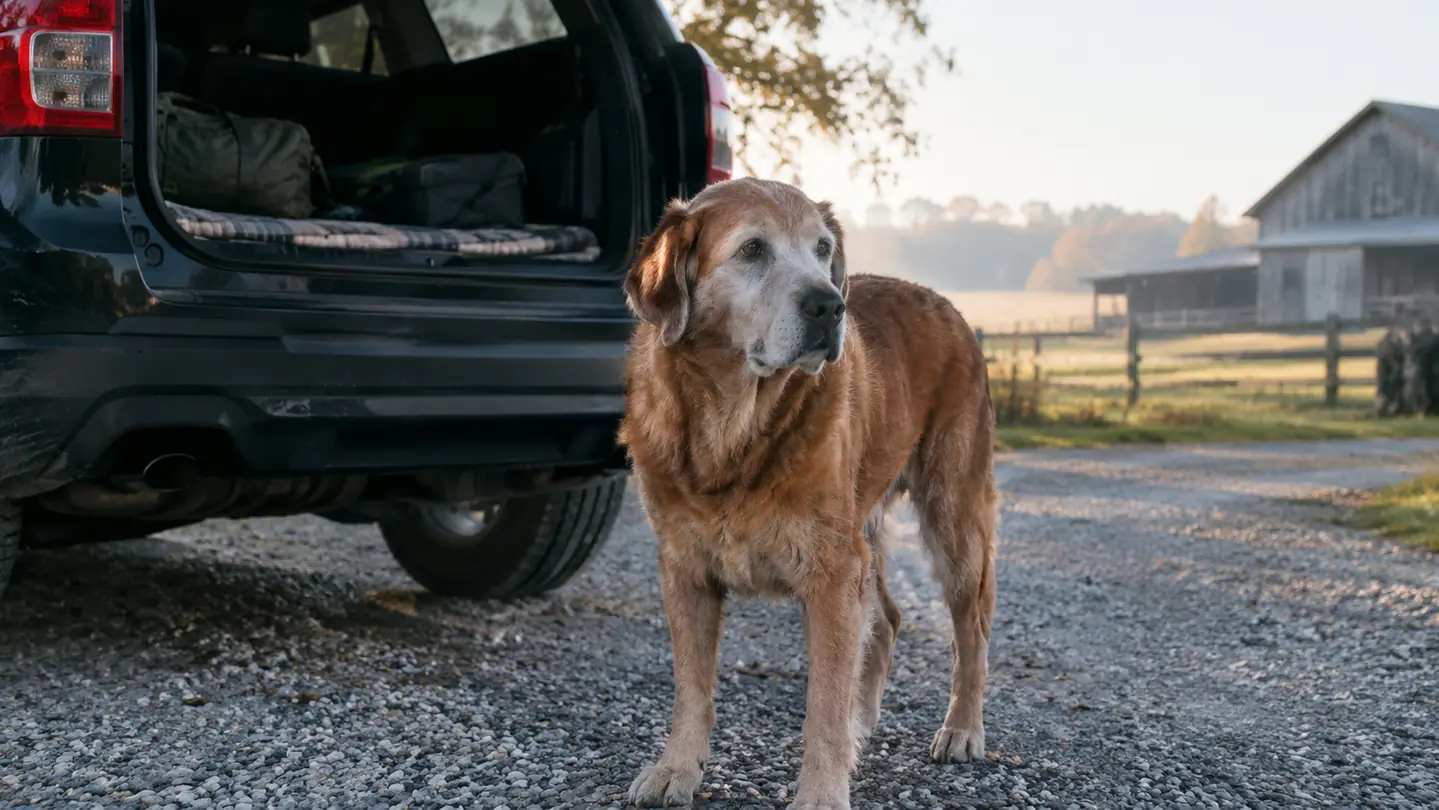
I stood at the back of my SUV with Murphy waiting at the open tailgate. He stretched his front legs up, tapped his back feet against the bumper, then stepped back and looked at me like he wanted to apologize. At 72 pounds and 10 years old, he is not a dog I can lift anymore, and I am not a person who should try. I could have asked for help, but Murphy does not like being lifted any more than I like lifting him. That was the day I started looking at dog ramps, and the PetSafe Happy Ride Folding Dog Ramp is the one that has been in my garage ever since.
Before I bought it, I read the reviews, all 15,000 of them. I watched the videos. I compared it to half a dozen other ramps with different designs. And I still ended up surprised by three things nobody warned me about: the weight of the ramp itself, how much the grip depends on details you cannot see in photos, and the setup learning curve. This is the honest version of that review, including the parts I got wrong at first.
The Quick Verdict
A sturdy folding ramp that does the job once you know what you are signing up for. Murphy walks up it without hesitation now, and that was worth the weight and the practice. Just plan where you will store it, keep the angle gentle, and give your dog two patient weeks to learn it.
Amazon Check Today's Price →The ramp that got Murphy back in the car without a lift
The PetSafe Happy Ride folds in half, grips well on the rubber tread, and carries a 72-pound dog with room to spare. If your dog is hesitating at the tailgate, this is the ramp I would start with.
Amazon Check Today's Price on Amazon →How I've Used It
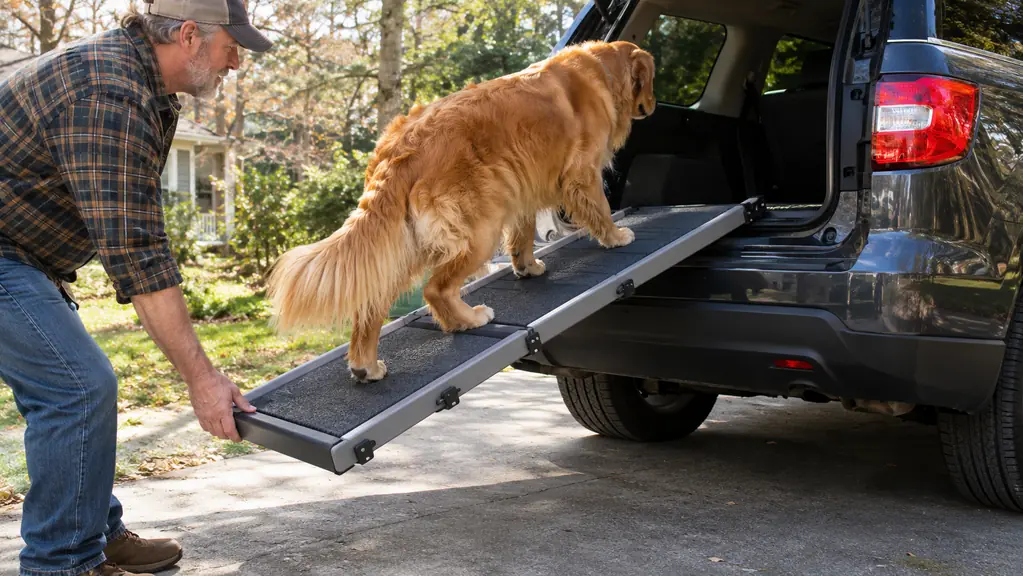
The PetSafe Happy Ride is a two-piece folding ramp, just under six feet long when it is open. You lay it against the back of an SUV, a truck bed, or a set of steps, and the raised lip at the top hooks over the edge so it stays put. The walking surface is a rubberized tread over a solid base, and it is rated for dogs up to 200 pounds. That sounded like overkill for my 72-pound Murphy until I remembered the rating has to cover a dog's momentum on the way down, and Murphy coming down a ramp is not a delicate operation.
Murphy gets a ride about four times a week: to the vet, to the groomer, and on the mornings when I take him along for errands. He used to pause at the open tailgate and look at the ground like he was doing math. Now he walks up on his own, which is exactly what the vet wanted. Less jumping means less landing impact on hips that are already creaky, and less weight on his front legs when he braces himself. For a dog his size, every jump out of an SUV is a small shock to the joints, and the ramp removes most of it.
The honest part: it took about two weeks of short practice sessions before Murphy would use it without a treat at the top. The ramp does not work the day it arrives for most dogs. You have to teach it, and I will get to exactly how in a minute.
What Nobody Tells You About the Weight
The product photos make this ramp look light. It is not. The PetSafe Happy Ride weighs roughly 17 pounds, and it is an awkward 17 pounds because the weight is spread across a long, flat surface. Folded in half, it is about the size of a large suitcase, but it is too wide to carry comfortably under one arm.
This matters more than the reviews suggest. I am 57, I go to the gym three days a week, and I still have to think about how I lift it. You do not carry it like a briefcase. You hold it flat against your body, one hand near the middle, forearm underneath, and you brace it with your hip. If you have shoulder trouble or a bad back, this is the detail to weigh before you order, because no product photo is going to warn you about it.
The upside is that the weight is what makes it feel planted. It does not wobble when Murphy walks up. The metal frame and thick base give it a solid, bridge-like feel that flimsier ramps do not have. So the tradeoff is straightforward: you carry more, and your dog walks on something that feels safe.
Where you store it changes how much the weight matters. I keep mine in the garage and carry it out to the car each time, which is the harder path. If you can leave it in the cargo area and just unfold it when you need it, most of the weight complaint disappears.
The Grip: What the Photos Do Not Show
The walking surface is a rubber tread with raised ridges, and it grips well when two things are true: the ramp is at a gentle angle, and your dog's toenails are trimmed. I learned both the hard way.
First, the angle. The back of my SUV sits higher than the ramp would like. If you rest the ramp at a steep angle, the grip is still there but the dog's weight shifts, and their feet slide forward on the way down. I started parking on a slight slope so the tailgate sits lower, and that changed everything. The lip at the top hooks over the tailgate edge, which helps, but you are still looking for the gentlest angle you can find.
Second, toenails. Murphy's nails were a little long when we started, and he slid twice on the way down. The tread grips paw pads, but long nails act like little skis. Once I got him on a regular nail routine, the sliding stopped. That is the kind of detail no product photo will ever show you.
The tread itself has held up. No peeling, no worn spots, even with a 72-pound dog going up and down several times a week. I wipe it down when it gets muddy, and it cleans up fast with a hose or a damp rag. One warning: the tread is dark, so mud and wet leaves are hard to see on it. I brush it off before I fold it, or the mess ends up in my garage.
Setup: The Part I Had to Learn the Hard Way
The ramp arrives folded in half with a locking mechanism on each side. Opening it is simple once you know the trick, but the first time I tried, I stood in my garage pulling at the wrong spots for five minutes while Murphy watched from the doorway like he was judging me. You press the release on both sides at the same time, then unfold it like a very long book. It is stiff when it is new, and that stiffness is a good thing because it means the joint is tight, but it does take hand strength, especially the first few times.
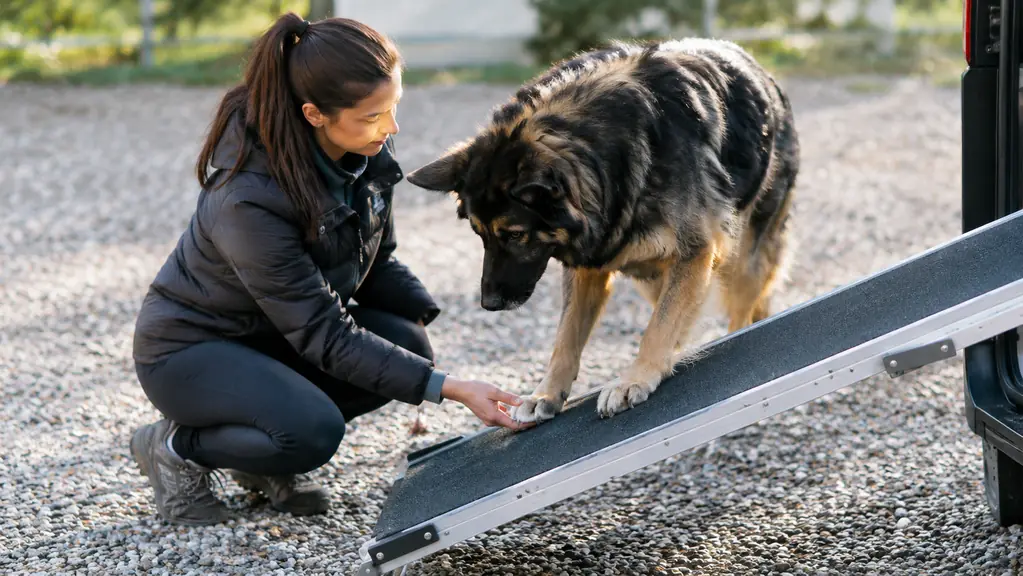
The bigger surprise was teaching Murphy to use it. The ramp makes more noise under a dog's paws than grass or carpet does, and Murphy froze the first time he stepped on it. I put a treat at the top, then one halfway up, then one at the bottom, and we practiced for about ten minutes a day for two weeks. Now he walks up without looking back, but I would not have believed that on day one.
The other setup detail nobody mentions is where the bottom of the ramp meets the ground. On my gravel driveway, the bottom edge sinks in a little, which is fine. On smooth concrete, the ramp can slide forward when the dog steps on it unless the bottom has something to catch on. I put a rubber mat under the bottom edge, and a piece of outdoor carpet does the same job. The mat also keeps the bottom from digging into soft ground, which makes the whole ramp sit steadier. It is a small fix, but you want to know about it before your first trip to the car, not after.
Folding it back up is the same process in reverse, and the locks click into place with a solid sound. Storage is the last thing to plan for. Folded, it is still about three feet long and a foot and a half wide, so it does not disappear into a closet. Mine leans against the garage wall, and it takes up less room than I expected but more than a yardstick.
Other Things Worth Knowing
The walking surface is roughly 15 inches wide, and Murphy, who is broad across the chest, has room to spare. I would not want it much narrower, and a really large breed would be more comfortable on a wider ramp, but for a 70-pound dog it is plenty.
I have also used it on my back porch steps, where Murphy was starting to hesitate. The ramp turns three steps into a gentle slope, and it is long enough to span them easily. It is not why I bought it, but it has become a second use I did not plan for.
It has already been through a hot Missouri summer in the back of my SUV, and the heat has not warped it or made the tread peel. The locks still click, and the frame still feels solid. I cannot speak to years of that, but it has handled the seasons so far without complaint.
The honest bottom line: the PetSafe Happy Ride is a well-built ramp with two real drawbacks, the weight and the learning curve, and both are manageable once you know they are coming. That is the part nobody tells you, and it is exactly why I wrote this.
What I Liked
- Feels solid underfoot. It does not wobble when a 72-pound dog walks up or down.
- Rubber tread grips well once the angle is gentle and nails are trimmed.
- Folds in half and locks securely, so it stores flat against a wall.
- Rated to 200 pounds, so there is plenty of margin for a large dog.
- Has held up through months of use with no wear on the tread and no loosening in the locks.
Where It Falls Short
- Weighs roughly 17 pounds and is awkward to carry, especially for someone with a bad back.
- Most dogs need a week or two of training before they will trust it.
- The bottom edge can slide on smooth concrete without a mat underneath.
- Folded size is still bulky, about three feet long.
- The walking surface is on the narrow side for very large breeds.
The tread grips paw pads, but long nails act like little skis. Once I got Murphy on a regular nail routine, the sliding stopped.
Who This Is For
This ramp is for owners of medium to large dogs who can still get into a car on their own but are starting to hesitate. If your dog can manage the jump but you can see it is getting harder, the ramp lets them keep that independence without the landing impact. It is also for anyone who has tried lifting a heavy dog into an SUV and realized that is not sustainable for either of you. And it is for people who want a ramp that feels solid underfoot, because the weight that makes it heavy to carry is the same weight that makes it steady.
It is also a good fit if you have a dog who still jumps but is starting to land stiffly. Murphy's vet told us the goal is to reduce impact while keeping him moving, and the ramp does exactly that. He still trots up the back porch steps on his own some days, but on the days when he is stiff, the ramp gives him an easier option, and he takes it.
Who Should Skip It
If your dog is small enough to pick up, you do not need a ramp this heavy. If you have a shoulder or back condition and you will be carrying it in and out of the car every day, look for a lighter ramp. If your dog is deeply afraid of new surfaces, know that the training curve is real, and some dogs never take to a ramp. Test one before you commit if you can. And if you need a ramp for a very large breed, measure your dog's width against the 15-inch walking surface before you order.
One more group: if you only need a ramp for a couple of porch steps and never put your dog in a car, a shorter, lighter ramp will do the job with less carrying and less storage space. Buy the ramp that matches the job you actually have. For us, the job was the car, and the porch was a bonus.
This is not a ramp you will forget you own. It is present in the garage, it takes a moment to carry to the car, and it takes two weeks of patient training before most dogs trust it. Knowing all of that ahead of time is the difference between a frustrating purchase and a useful one. I am glad I bought it, and I would buy it again, but I would have been a lot less annoyed in week one if someone had told me these three things. That is the whole point of this review, and I hope it saves you the week I spent figuring it out.
If your dog is hesitating at the tailgate, this is where I would start
The PetSafe Happy Ride is the ramp I reach for every time. It is not the lightest ramp you can buy, and it asks for a little patience during training, but it is the one Murphy will actually walk up, and that is the whole point. Check the current price and read the recent reviews before you decide.
Amazon Check Today's Price on Amazon →