

The morning I realized Murphy was getting old, he didn't limp and he didn't cry. He just stood at the bottom of the three back porch steps and looked at them like they were a wall. My 10-year-old yellow Lab mix, 72 pounds of a dog who had never hesitated at anything in his life, needed a full ten seconds to decide whether the steps were worth it. That was the morning I started reading about omega-3s, and the morning I started dreading the fight I assumed was coming: me, a bottle of fish oil, and a dog who turns his nose up at anything that smells different.
Here is what I learned after a month of adding Nordic Naturals Omega-3 Pet to his dinner bowl: the fight is mostly optional. The fish oil itself is doing what I hoped, and the part I was braced for, the part where Murphy refuses to eat and I end up with a greasy spoon and a guilty conscience, never really happened. It took a little patience and one small change in how I served it. If you are standing where I was, with a bottle in one hand and a skeptical dog at your feet, this is the exact routine that worked for us.
The fish oil that made Murphy stop hesitating at the porch steps
Nordic Naturals Omega-3 Pet is the bottle I reach for every evening. It is a liquid, so it mixes into food instead of being a pill you have to hide. See today's price on Amazon and read what other owners of senior dogs say.
Amazon Check Today's Price on Amazon →Step 1: Talk to your vet before you buy anything
I am not a vet, and I am not going to pretend otherwise. Before I ordered anything, I called Murphy's vet on a Tuesday morning and asked whether fish oil was a good idea for a 10-year-old dog with mild arthritis and a new hesitation on the steps. She said yes, gave me a dose range, and told me the one thing I would not have known to ask: some dogs on fish oil need their other food adjusted, because the oil adds calories and fat. Murphy is 72 pounds and carries it well, but I still wanted to know what I was doing before I changed his dinner.
Your vet knows your dog's history, weight, and any medications. Fish oil can interact with certain drugs, and the right dose depends on your dog's size and health. A five-minute phone call is cheaper than a guess, and it means you start with confidence instead of second-guessing yourself every time you pick up the bottle.
When the vet gave me the go-ahead, I ordered Nordic Naturals Omega-3 Pet. I chose it because the label lists the actual amounts of EPA and DHA, the two omega-3s that matter for joint and heart health, instead of just saying "fish oil." That specificity is the whole reason I trusted it over the cheaper bottles on the shelf. I also checked the ingredient list for anything I did not recognize, and the short list made sense to me: fish oil, natural flavor, and vitamin E to keep it fresh. That was the first time a supplement label actually made me feel calmer instead of more confused.
Step 2: Start with a half dose and build up over a week
The biggest mistake I almost made was starting Murphy at the full dose on day one. Fish oil is a fat, and a sudden spoonful of fat can upset a dog's stomach. The bottle's label gives a range based on weight, and the lower end of that range was the right place to start for a dog who had never had fish oil before.
For the first three days, I gave Murphy about half of the recommended amount for his weight, mixed into his dinner. By day four I moved to three quarters, and by day seven he was at the full amount. His digestion stayed normal the whole time, which told me his system was adjusting the way it was supposed to. If your dog gets loose stools or seems uncomfortable, that is a sign to back off and call your vet. It does not mean fish oil is bad. It means the ramp-up was too fast.
One more thing I did during that first week: I kept a little note on the fridge with the date and the dose. It sounds silly, but when you are tired at 6 p.m. and the dog is dancing at your feet, it is easy to lose track of whether you already gave the evening dose. The note saved me at least twice, including one night when I was sure I had skipped the evening pump and the note proved I had not. On the third day, I also wrote down what time Murphy ate, because I wanted to see whether an earlier dose sat differently than an evening one. It did not, but having the record made me feel like I was paying attention instead of guessing.
Step 3: Warm the oil slightly and mix it into something sticky
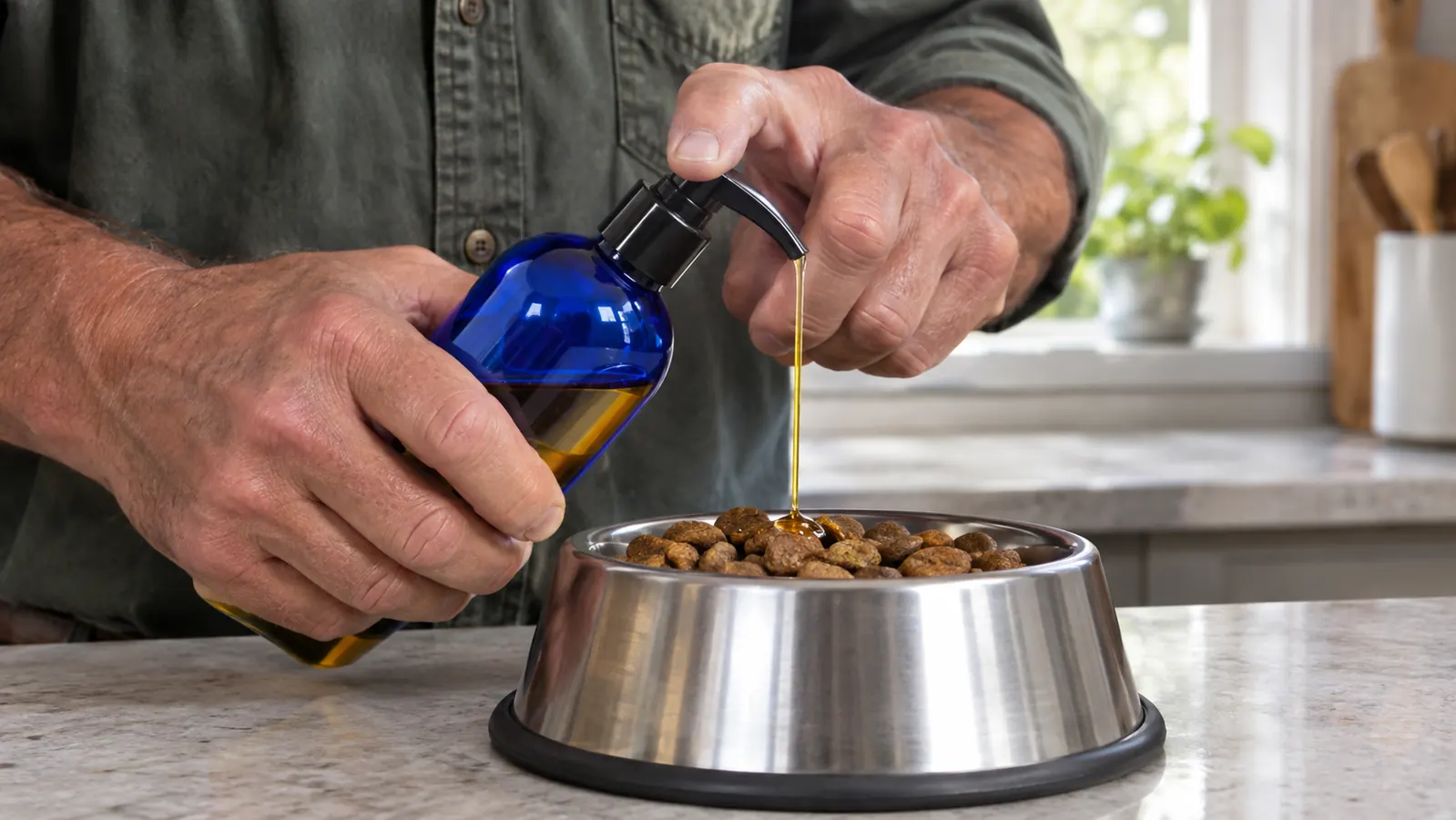
Here is the trick that ended the fight before it started. Fish oil straight from the fridge is cold, and cold oil sits on top of the kibble like a slick that a picky dog can smell a mile away. I started taking the bottle out of the fridge about ten minutes before dinner, and I gave the pump a few extra presses into the bowl so the oil had a chance to warm up. Then I mixed it into a spoonful of plain canned pumpkin before stirring it into Murphy's food.
The pumpkin does two things. It gives the oil something to cling to instead of pooling at the bottom of the bowl, and it adds a flavor most dogs already like. Murphy is not a dog who eats anything, but he has never once turned down pumpkin. The oil disappeared into it, the pumpkin disappeared into the kibble, and dinner went down without a single suspicious look. The first night I tried it, I stood there watching him eat, waiting for the moment he would stop and walk away. He finished the bowl, looked up at me, and then checked the kitchen floor in case I had dropped something. That was the moment I stopped worrying about the fight.
If your dog does not like pumpkin, plain unsweetened applesauce or a little warm water mixed into the food works the same way. The goal is to coat the kibble so the oil is not sitting on top where the dog can smell it and decide the whole bowl is ruined. You are not hiding anything from your dog. You are just making the food smell like food instead of like a supplement.

Step 4: Serve it at the same time every day, in the same bowl
Dogs are creatures of routine, and Murphy is more of a creature of routine than most. Once I started serving his fish oil at the same time every evening, in the same stainless steel bowl, he stopped treating it like an event. It became part of dinner, the way his regular kibble is part of dinner. He stopped sniffing the bowl before he ate. He just ate.
I also learned to pump the oil directly onto the food rather than into a spoon first. That sounds like a small thing, but it meant one less dish to wash and one less step where the oil could end up on the counter instead of in the bowl. The pump on the Nordic Naturals bottle makes it easy to measure, and the bottle is designed to be stored in the fridge, which keeps the oil fresh between doses. I keep it on the middle shelf, right next to the milk, so I cannot miss it when I am making dinner.
Consistency matters for another reason too. Omega-3s build up in the body over time. They are not a painkiller that works in an hour. Giving the same dose at the same time every day means your dog gets a steady level, which is what actually gives you a fair chance to see whether it is helping.
Step 5: Give it a full month before you judge the results
The hardest part of adding fish oil to a senior dog's food is not the fish oil. It is the waiting. I expected to see a difference in a week, and when Murphy still hesitated at the steps after seven days, I almost stopped. I am glad I did not. By the end of the first month, the hesitation was shorter. By the end of the second month, he was taking the steps the way he used to, without pausing to think about it.
I want to be careful here, because I do not want you to read this as a promise. Fish oil is not a cure, and every dog is different. Murphy's improvement was real but modest, the kind of change you notice in hindsight rather than the kind that makes you call your neighbor. For a dog with more serious joint issues, the results may be different, and your vet is the one who can tell you what to expect.
What I can tell you is that the routine is easy enough to keep going. A few pumps, one bowl, one minute at dinner. That is the whole cost of giving Murphy something that might be helping his joints, his heart, and his coat. When the bottle ran low, I ordered another one without thinking twice. I also made a note on my calendar for the first of the month to check in with the vet and mention that we had been using it, so she could tell me whether to keep going or adjust the dose.
What Else Helps
Fish oil was the first thing I added, but it was not the only thing. The same month I started Murphy on Nordic Naturals Omega-3 Pet, I also made two changes that cost nothing. I put a rubber-backed runner on the back porch steps so he would not slip, and I started waiting for him at the top of the steps instead of walking ahead. Both of those made the steps feel safer to him, and a dog who feels safe moves more easily.
I also started paying attention to his weight in a way I had not before. Every extra pound on a senior dog is extra weight on the joints, and Murphy is the kind of dog who would eat until the bowl was empty and then look for more. Keeping him at a healthy weight, with the vet's guidance, is probably doing as much for his joints as the fish oil is. The two work together.
If you are looking for other things to add to your dog's routine, talk to your vet about joint supplements that contain glucosamine and chondroitin. Some dogs do well on those, and some do well on fish oil, and some do well on both. The key is to add one thing at a time so you know what is actually helping. That is how I knew the fish oil was worth keeping: I changed nothing else during the first month.
By the end of the first month, Murphy was taking the back porch steps the way he used to, without pausing to think about it. That is the kind of change you notice in hindsight, not the kind that makes you call your neighbor.
A month from now, you could be glad you started today
The routine takes one minute a day: pump, mix, serve. Nordic Naturals Omega-3 Pet is the bottle I keep in my fridge, and it is the one I would buy again. Check today's price on Amazon and see what other owners of senior dogs have to say.
Amazon Check Today's Price on Amazon →