
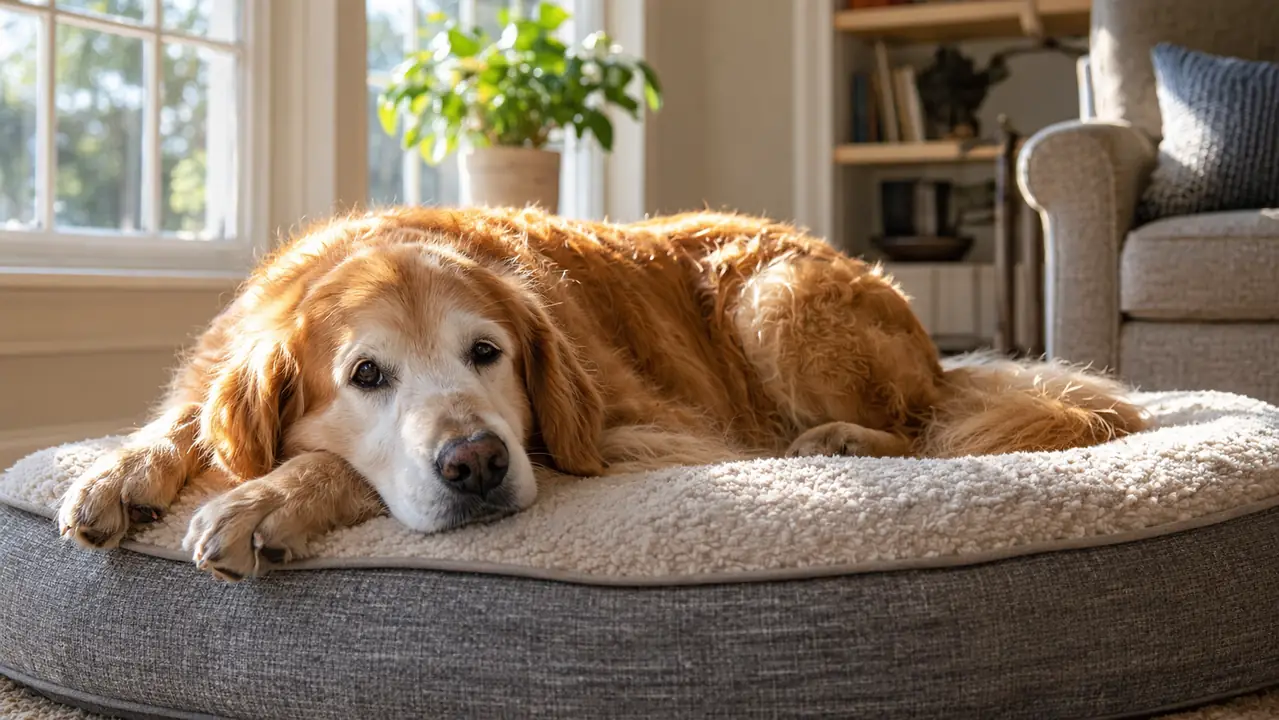
The first time Murphy hesitated at the back porch steps, I told myself he was just tired. Then he started getting up slowly after naps, and I caught him standing beside his old flat bed instead of lying down on it. My vet said his hips were stiff, not broken, and that a good orthopedic bed could take some pressure off his joints. That sent me down a rabbit hole of foam densities, cover fabrics, and waterproof liners. If you are trying to choose an orthopedic bed for a large senior dog, here is what I learned, including why I ended up with the EHEYCIGA Orthopedic Dog Bed for Murphy.
I am not a vet, and I am not going to pretend to be one. I am a 57-year-old retired school office manager in northern Missouri with a 10-year-old yellow Lab mix who weighs about 72 pounds. I read labels, I watch how Murphy moves, and I tell you what I found. If your dog has a real diagnosis, talk to your vet first. This guide is about the bed, not about replacing medical advice.
A bed that actually supports a 72-pound senior dog
The EHEYCIGA Orthopedic Dog Bed has the thick memory foam, waterproof liner, and washable cover that I looked for when Murphy's hips started bothering him. See today's price and current options on Amazon.
Amazon Check Today's Price on Amazon →Step 1: Measure your dog, not the room
Before you look at any bed, measure your dog from the tip of the nose to the base of the tail while they are standing. Then add about 6 to 8 inches. That is the minimum bed length you want. Last October, when Murphy had been hesitating on the back porch steps for a couple of weeks, I finally got out the tape measure. He stood at the kitchen counter watching me while I measured him: 36 inches even. His old bed was 30 inches long, and when I looked at him stretched out on it, his head hung off the edge by a good four inches. That was the moment I understood the bed was part of the problem, not just his hips. I added eight inches to his length and made 42 inches my absolute minimum. A bed that is too short means your dog's head or hips hang off the edge, which defeats the whole purpose.
Also think about how your dog actually sleeps. Murphy curls up sometimes, but he also stretches out flat on his side, especially when his hips are sore. He does the same thing every night: he curls up for the first hour, then rolls onto his side with a little grunt and stretches out. A rectangular bed with a little extra room works better for a dog that changes positions. A round bed with a raised rim all the way around looks cozy, but there is no flat stretch for a dog that likes to lie on his side. The EHEYCIGA bed I chose comes in a large size that gives Murphy room to stretch without hanging off, and the raised sides give him a place to rest his head when he wants to curl.
One more thing: measure the space where the bed will live. A 42-inch bed takes up real floor space. I cleared a corner of the living room and measured it before I ordered, so I was not stuck with a bed that did not fit the room.
Step 2: Check the foam thickness and density
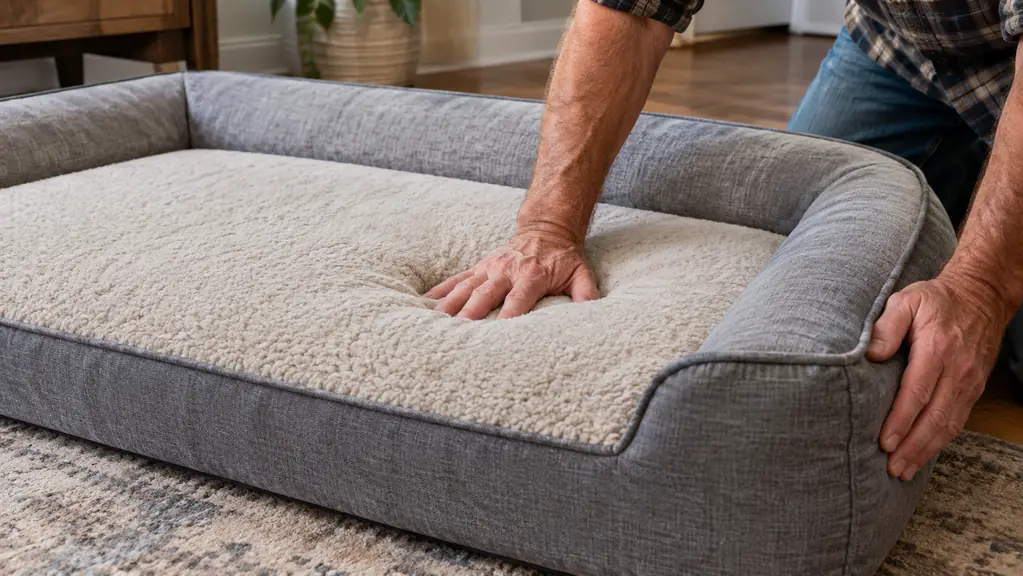
This is the step that separates a real orthopedic bed from a pillow with a fancy name. A 72-pound dog sinks straight through a thin foam pad and ends up lying on the floor through the fabric. I learned this the hard way. Before I settled on the EHEYCIGA bed, I tried a cheaper foam bed from a big box store. It felt fine in the store, but within three weeks Murphy was lying on the floor through it. I knelt on it myself one evening and I could feel the hard floor through the foam, which is exactly what his hips were feeling all night. That experiment convinced me to stop choosing the cheapest option and start looking at the foam instead. What you want is high-density memory foam that is thick enough to keep your dog's body from bottoming out. The EHEYCIGA bed has a thick memory foam base, and when I press my hand into it, it springs back slowly instead of collapsing.
Look for the foam thickness in the product description. If the listing does not say how thick the foam is, that is a red flag. For a large dog, I would not go under 4 inches of supportive foam. When the EHEYCIGA bed arrived, I measured the foam with a ruler before I put the cover on, and it matched the listing. That told me the company was not stretching the truth. The foam is thick enough that Murphy's hips do not press through to the floor, and I can feel the difference when I kneel on it myself.
Density matters too. A soft, squishy foam feels nice for five minutes, but it does not support a heavy dog through a full night. High-density memory foam holds its shape and supports the heaviest parts of the body, which is exactly what a senior dog with stiff hips needs.
Step 3: Look for a waterproof liner and a washable cover
Senior dogs have accidents. It is not their fault, and it is not a moral failing. Murphy has always been good about letting me know when he needs out, but last winter he had a leak one night while he was sleeping so deeply he did not even wake up. His old bed absorbed it, and no amount of washing got the smell out of the foam. I threw that bed away a week later. A bed with a waterproof liner protects the foam from urine, which means the bed does not hold odors and does not break down from moisture.
The EHEYCIGA bed has a waterproof liner under the cover, and the cover itself is removable and machine washable. That combination is the one I would not skip. I checked the liner carefully before I ordered, because some beds call themselves waterproof but only have a water-resistant cover, which is not the same thing. A bed with a non-removable cover is nearly impossible to clean properly, and a bed that cannot be cleaned is a bed that ends up in the trash after a few months.
When you wash the cover, follow the care instructions. I wash Murphy's cover on a gentle cycle with a mild detergent and let it air dry. It takes about a day to dry completely, so I wash it on a morning when I know Murphy will be napping on the living room rug. The waterproof liner stays in place, so the foam stays dry and the bed is ready to go back together quickly.
Step 4: Consider the sides, the bottom, and the height
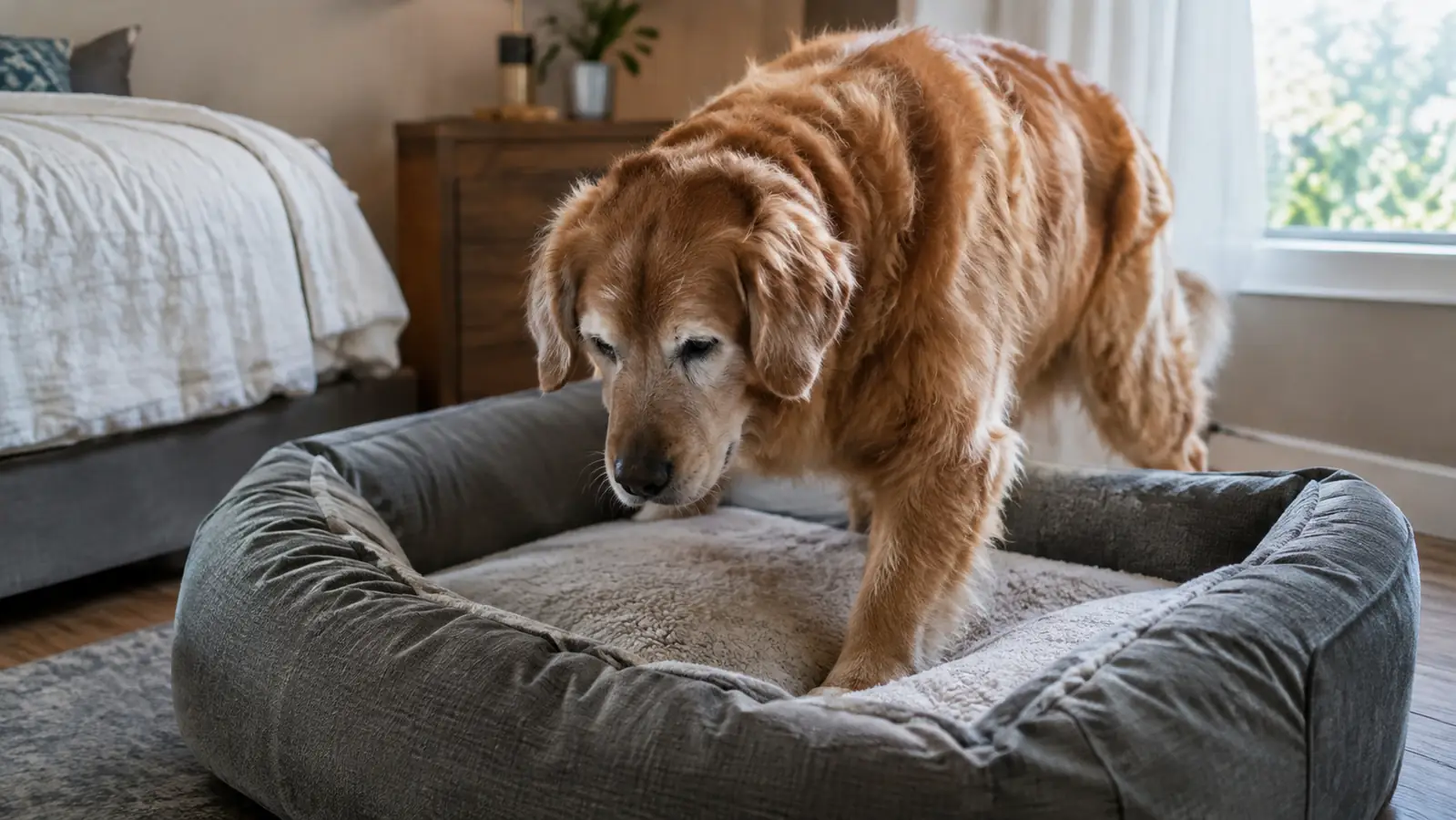
Raised sides do more than look nice. They give a senior dog a place to rest their head, and they create a sense of security that helps some dogs settle. Murphy likes to tuck his head over the edge of the raised side when he is curled up. The first night, I watched him circle once, then drop his head over the side and sigh. He had never done that on his old flat bed. It sounds like a small thing, but that sigh told me he finally felt like he had a place to put his head. The EHEYCIGA bed has raised sides on three sides, which gives him that support without making it hard for him to step in and out.
The bottom of the bed matters more than most people think. A bed that slides across the floor is dangerous for a dog with stiff hips, because the dog has to brace themselves just to get on and off. His old bed slid a few inches every time he got on or off, and over time it had drifted halfway across the room. I would push it back every morning. The EHEYCIGA bed has a non-slip bottom, and it has not moved more than an inch since I put it down. That was a big deal for me, because Murphy already hesitates on the porch steps, and I did not want him slipping in the living room too.
Height is a tradeoff. A thicker bed is more supportive, but it is also a bigger step up for a dog with sore hips. Murphy manages the height of the EHEYCIGA bed fine, but if your dog has very limited mobility, look for a bed that is thick but still low enough for them to step onto comfortably. I put Murphy's bed against the wall for that exact reason. He uses the wall to steady himself when he gets up in the morning, and it makes the step up and down noticeably easier for him.
Step 5: Read the reviews for your dog's size, not just the star rating
A 4.5-star rating is nice, but the star rating does not tell you how the bed works for a 72-pound dog. Read the reviews from people who own large breeds and senior dogs. Look for comments about whether the foam holds up, whether the cover washes well, and whether the bed slides. Those details tell you more than the average score.
The EHEYCIGA bed has over 23,000 ratings, and I read a lot of them before I ordered. I looked specifically for reviews from owners of Labs, Goldens, and other big dogs, and I found plenty of people describing the same situation I was in: an older dog that needed more support. One owner said her 85-pound German Shepherd had stopped crying when he got up in the morning after two weeks on the bed. Another said her elderly Golden Retriever slept through the night for the first time in months. Those were the reviews that made me stop second-guessing and place the order.
Also read the negative reviews. Every product has some, and they tell you what could go wrong. Some people said the bed was not as thick as they expected, which is why measuring and checking the foam specs matters. Others said the cover was hard to get back on after washing, which is a minor annoyance but not a dealbreaker for me. A few owners of small dogs said the bed was too firm, which actually made sense to me. A little dog does not weigh enough to sink into high-density foam the way a 72-pound dog does. Reading those complaints helped me more than the five-star reviews did, because they confirmed the bed was built for the kind of dog I have.
What Else Helps
A good orthopedic bed is one piece of the puzzle, not the whole answer. I also put a nonslip rug under the bed so Murphy has traction when he gets up, and I keep his nails trimmed so he does not slip on the floor. I wipe his paws after he comes in from the gravel driveway so he does not track grit onto the clean cover. I talked to my vet about joint supplements and gentle exercise, and I try to keep Murphy's weight steady, because every extra pound is extra load on his hips. The bed helps him rest better, but the rest of the routine is what keeps him moving.
The first morning after the EHEYCIGA bed arrived, Murphy slept through the night and got up without the slow, careful shuffle he had been doing for weeks.
Give your senior dog a better place to rest
If your large dog is stiff after naps or slow to get up, a supportive orthopedic bed can make a real difference. The EHEYCIGA Orthopedic Dog Bed is the one I chose for Murphy. Check today's price on Amazon.
Amazon Check Today's Price on Amazon →