
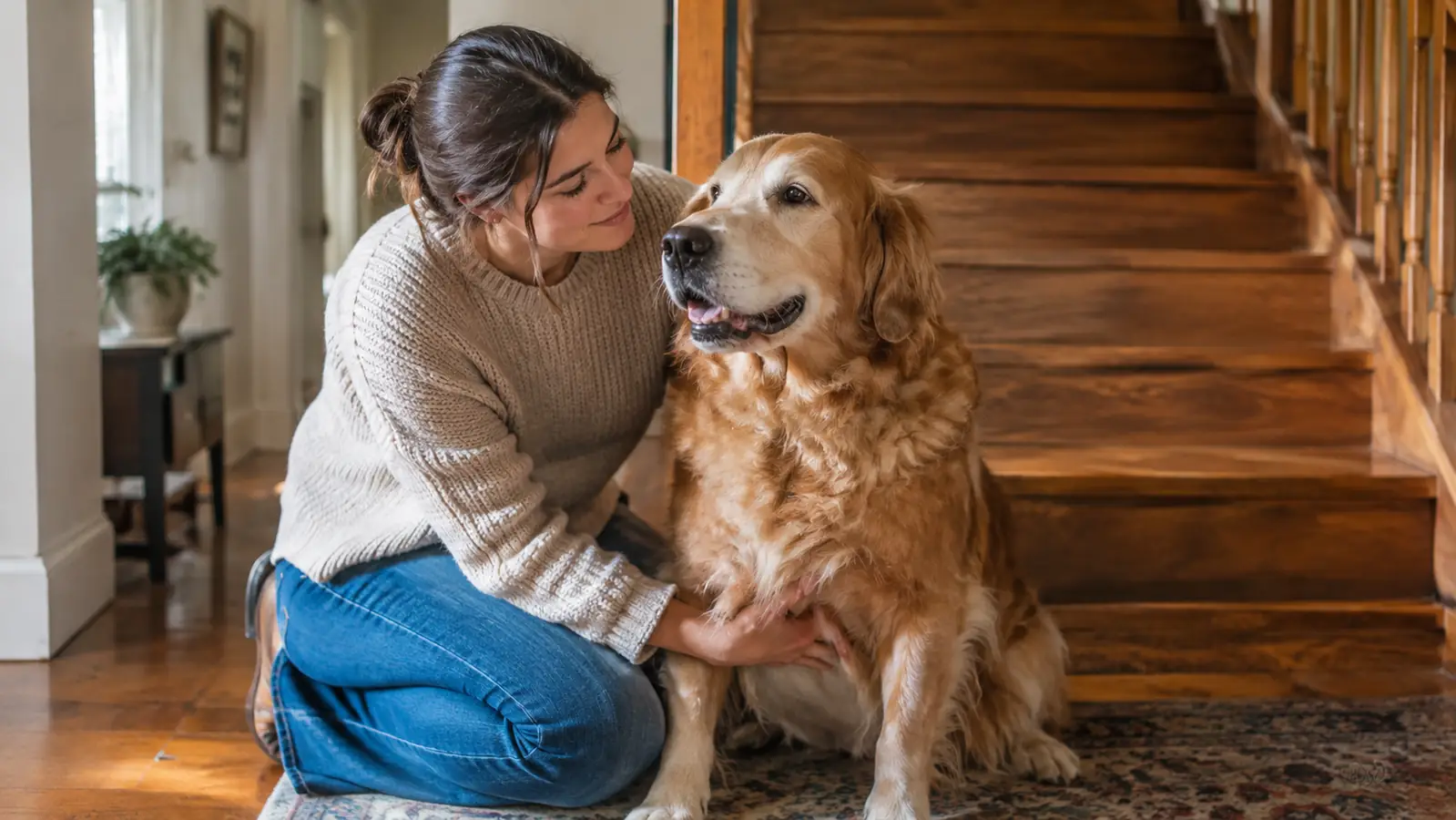
The first time Murphy stopped at the bottom of the porch steps, I thought he was just being stubborn. He is a 10-year-old yellow Lab mix, about 72 pounds, and he has always been the first one through the door. Then he started pausing at the top of the landing, looking down at the three steps like he was doing math in his head. Our house is a one-story with just three back porch steps, so stairs were never something I worried about. But when your dog starts hesitating on three steps, you start thinking about every staircase you have ever asked him to climb.
I am not a vet, and I want to be clear about that up front. I am a retired school office manager who has spent the last year watching a good dog get older. When Murphy began getting up slowly after naps and bracing himself before stepping up, I did what I always do: I read labels, I asked questions, and I looked for something that would help without making things worse. What helped us was a lift harness, specifically the LOOBANI Dog Lift Harness for Large Dogs. This guide is the step-by-step routine we worked out together, the one I wish someone had walked me through the first time I held those handles.
The harness that got Murphy up the porch steps without a single grumble
The LOOBANI Dog Lift Harness supports the hindquarters while your dog does the walking. It is the tool I reach for every time we head for the steps.
Amazon Check Today's Price on Amazon →Step 1: Measure your dog before you do anything else
The biggest mistake I almost made was ordering a size based on Murphy's weight alone. Lift harnesses are not like collars. The part that matters is the girth around the deepest part of the chest, right behind the front legs, and the length from that point back to the base of the tail. The LOOBANI harness comes in sizes that are tied to those measurements, and the listing explains exactly where to hold the tape. I used a soft fabric measuring tape, the kind from a sewing kit, and I measured twice because Murphy kept trying to sit down.
Write the numbers down before you open the product page. If you are between sizes, the general advice is to size up so the padded panels sit comfortably around the rear legs. A harness that is too small will dig in, and a harness that is too loose will slide around and do nothing useful. When ours arrived, I adjusted the straps while Murphy stood on the kitchen floor, and I checked that I could fit two fingers flat under every strap. That is the same fit check I use for his regular walking harness, and it has never steered me wrong.
If you are not sure about sizing, the LOOBANI listing has a size chart with the chest and back measurements for each option. I also called our vet's office and asked the technician to double-check my numbers over the phone. She did, and it took less than two minutes. That phone call is the single best piece of advice I can give you, because a lift harness only works when it fits.
Step 2: Put the harness on while your dog is standing
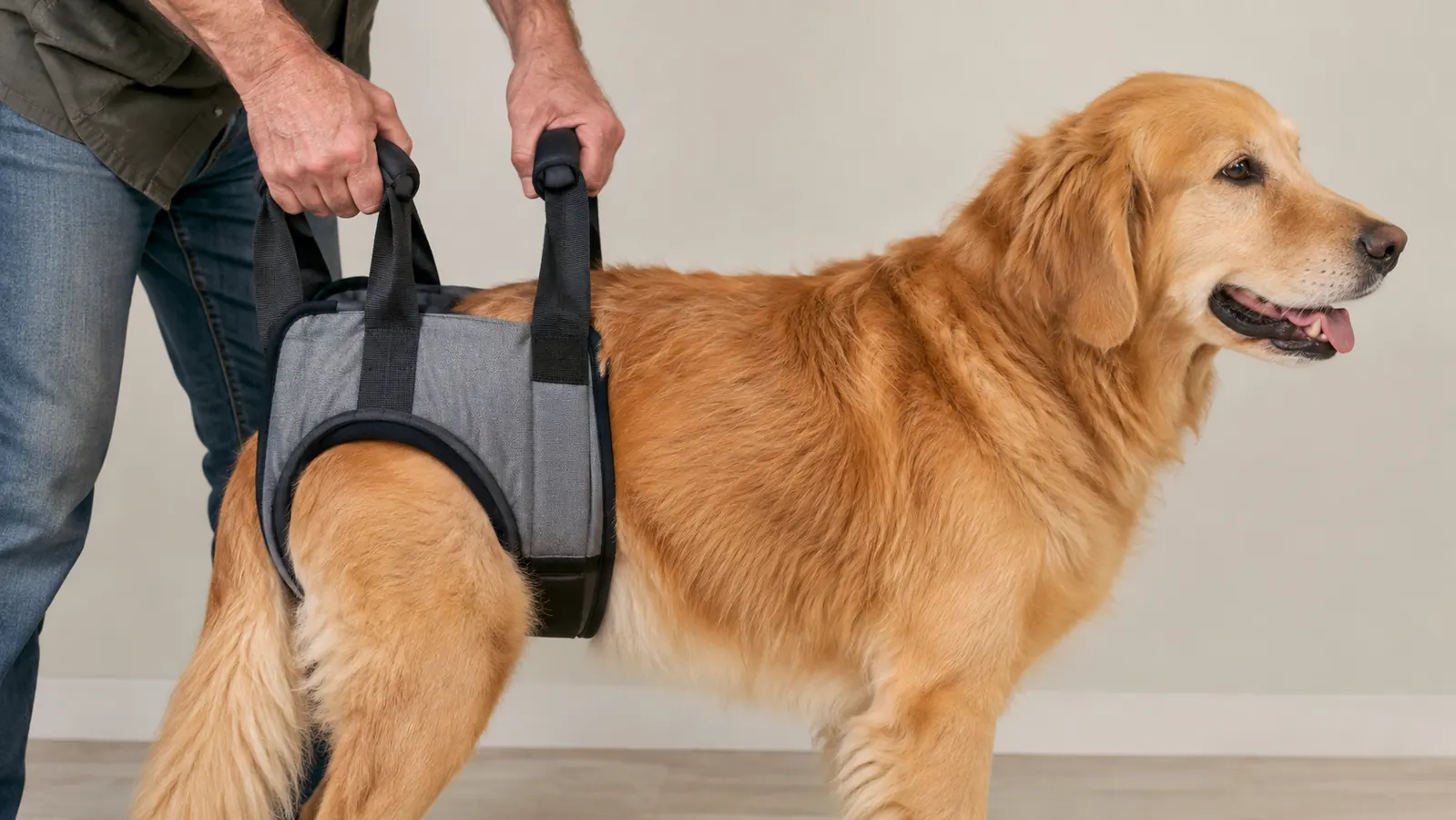
The first time I tried to put the LOOBANI harness on Murphy, I made the mistake of asking him to sit first. He sat, I fumbled with the straps, and then I had to ask him to stand while I was still holding the harness in place. It was awkward for both of us. The easier way is to start with the dog standing on a flat, non-slip surface. I use the kitchen floor because Murphy stands still there, probably because he knows the treat jar is two feet away.
The harness has two padded sections that wrap around the rear legs, and the handles sit over the top of the back. I lay the harness over Murphy's back first, then bring each padded loop around the outside of a rear leg, then fasten the belly strap. The order matters more than you would think. If you fasten the belly strap first, the leg loops end up twisted and you have to start over. I have done it wrong enough times to know.
Once it is on, do a quick check before you move anywhere. The handles should sit over the middle of the back, not off to one side. The padded loops should cup the rear legs without rubbing. And the whole thing should feel snug but not tight. If Murphy can walk around the kitchen comfortably with the harness on, we are ready for the next step. If he is walking funny, I take it off and start again.
Step 3: Practice lifting on flat ground before you touch a step
Do not start on the stairs. I know it is tempting, because the stairs are the whole reason you bought the harness. But the first few times you use a lift harness, both you and your dog are learning a new movement, and you want to learn it on flat ground where nobody is worried about falling. I spent two days just walking Murphy around the yard with the harness on, using the handles to take a little weight off his back end every few steps.
The motion is not a full lift. It is a gentle assist. You grip the handles, and when your dog steps forward, you use the handles to support maybe a third of his weight, just enough to take the strain off the rear legs. The LOOBANI harness is designed for this kind of partial support, with padded handles that do not dig into your hands. I have small hands, and I was worried the handles would be too thick. They are not. They are grippy without being bulky.
Here is what I want you to practice: walk beside your dog, hold the handles lightly, and every time he takes a step with a rear leg, add a tiny bit of upward support. You are not carrying him. You are just taking the edge off. When Murphy figured out that the harness made stepping feel easier, he stopped hesitating. That is the moment I knew we were onto something.
Step 4: Work the stairs one step at a time
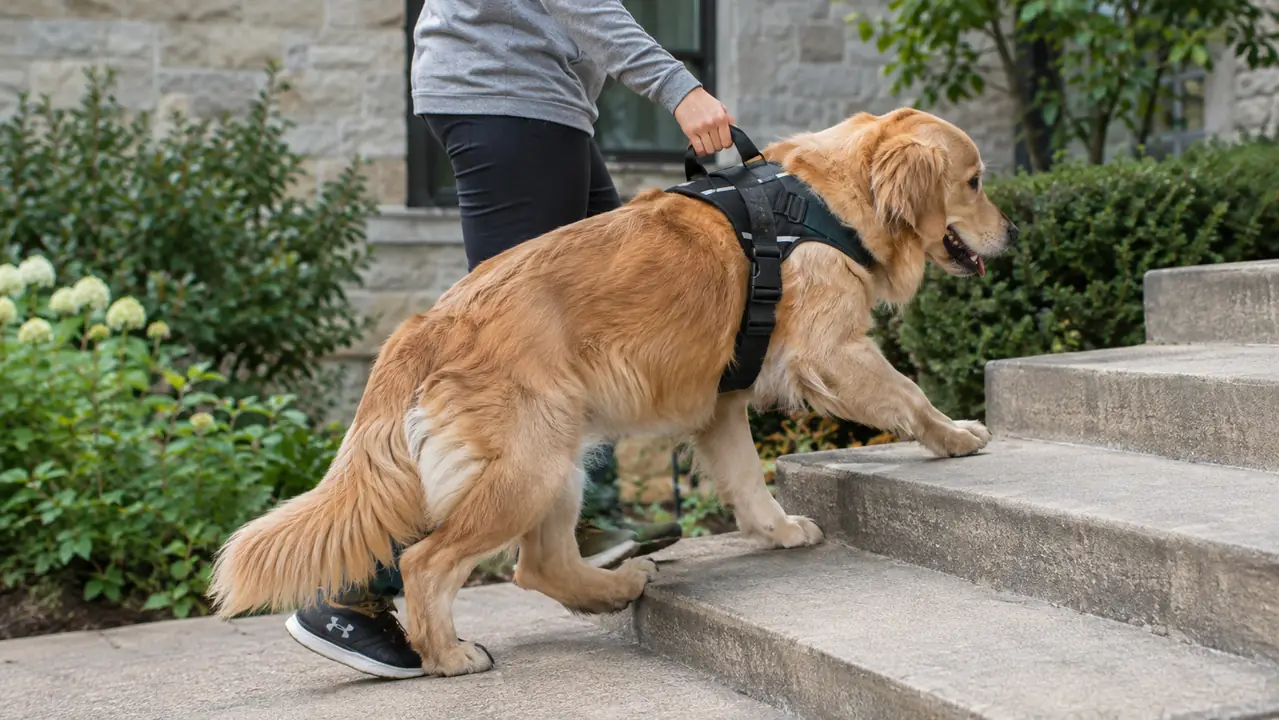
When you are both ready for the real thing, start with the smallest set of stairs you have. For us, that is the three back porch steps. I stand beside Murphy, slightly behind him, with one hand on the harness handle and my other hand free to steady myself on the railing. I let him set the pace. I do not pull him up the steps. I just follow his movement and use the handle to support his rear end as he pushes off with his front legs.
The rhythm matters more than the strength. As Murphy steps up with a front paw, his rear end naturally rises, and that is the exact moment to add support with the handle. You are helping the rear legs follow the front legs. If you lift too early, you throw off his balance. If you lift too late, you are not helping. It took us about a week to find the rhythm, and now it feels automatic. I do not even think about it anymore.
One thing I learned the hard way: do not stand directly behind your dog on the stairs. If he slips, you want to be beside him, not behind him, so you can support him sideways if you need to. And take breaks. Murphy can do the three porch steps in one go now, but in the beginning we stopped halfway up the landing so he could catch his breath. There is no prize for doing the whole flight at once.
Step 5: Build a routine and watch for the signs that matter
The harness is not a cure, and I do not want you to think it is. What it does is remove the fear and the strain from a movement your dog still wants to make. Murphy still gets up slowly after a long nap. He still prefers the sunny spot on the living room rug over the hard floor. But he does not stand at the bottom of the porch steps doing math in his head anymore. He waits for me to pick up the harness, and then he walks up like he used to.
We use the LOOBANI harness every time we go outside now, not just on stair days. It gives me a way to help him into the car, and it gives him a little confidence on uneven ground in the yard. I keep it hanging on a hook by the back door, right next to his leash, so we never have to go looking for it. Routine matters for older dogs. When the harness is part of the regular getting-ready ritual, it stops being a big deal.
Watch for the signs that matter. If your dog is suddenly unable to bear weight on a rear leg, or if the hesitation gets dramatically worse overnight, that is a vet visit, not a harness adjustment. The harness is for the slow decline, the stiffness after naps, the hesitation on steps. It is not a substitute for medical care. I check in with our vet every few months about Murphy's mobility, and I would tell you to do the same.
What Else Helps
The LOOBANI harness is the tool that made the biggest difference for us, but it is not the only thing that helped. I put a rubber-backed mat at the top and bottom of the porch steps so Murphy's paws have something to grip. I trimmed the bushes along the walkway so he has a clear, wide path. And I stopped rushing him. Older dogs need more time to get their legs under them, and giving Murphy that extra minute has saved us both a lot of stress.
I also talked to our vet about joint support. We started Murphy on a daily joint supplement around the same time we got the harness, and our vet was clear that it would not fix anything overnight. It is a slow, cumulative thing. The harness helped immediately, the supplement helped over months, and together they have kept Murphy moving better than I expected. If you are thinking about supplements, ask your vet first. Every dog is different, and what worked for Murphy may not be right for your dog.
The first time Murphy walked up the porch steps without hesitating, I almost cried. It was not a big dramatic moment. It was just him, walking up three steps like he used to, with me holding the handle and taking a little weight off his back end.
Give your dog the support to keep doing the things they love
The LOOBANI Dog Lift Harness for Large Dogs is the tool that helped Murphy with the porch steps, the car, and the yard. It is not a cure, but it is honest, practical help.
Amazon Check Today's Price on Amazon →