
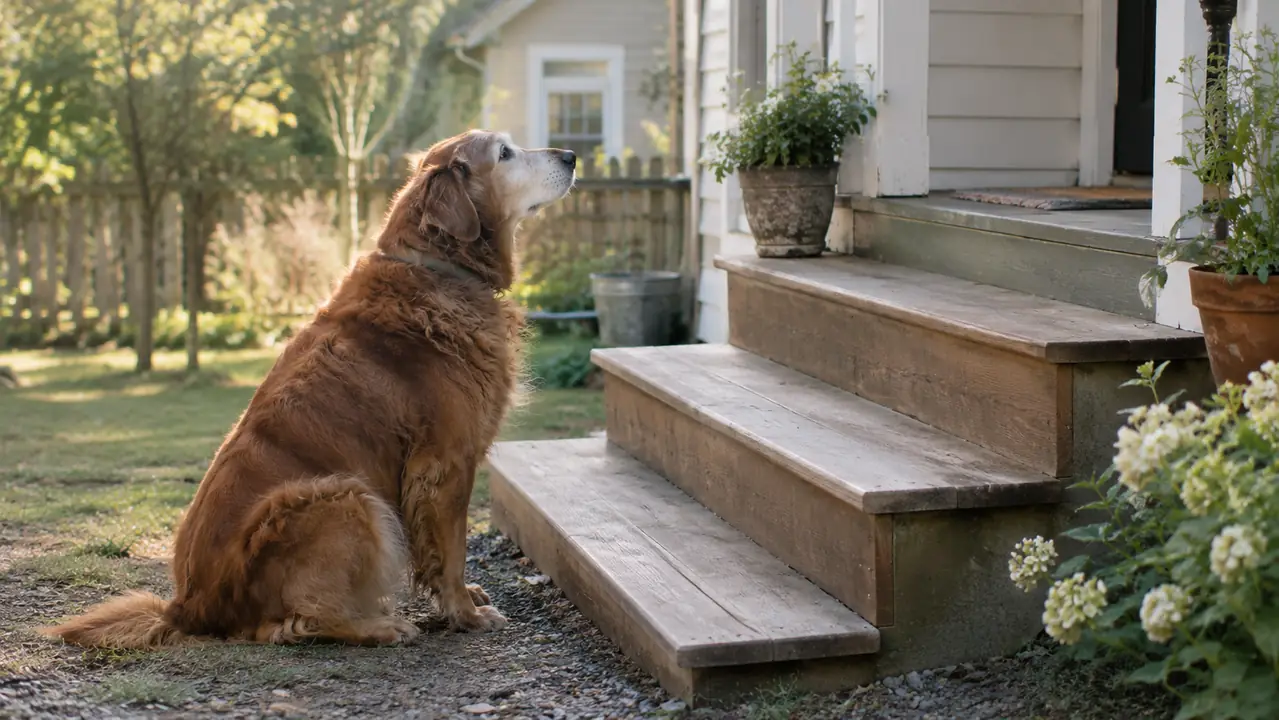
Murphy has been mine for eight years, and for most of that time he treated the three back porch steps like they were nothing. Now he stops at the bottom of them. He looks up, takes a breath, and then he launches himself, and the landing is harder than it used to be. That was the first thing I noticed. The second thing was the way he got up from his naps, slow and stiff, his back legs doing most of the pushing while his front end did the pulling. My vet said the word 'arthritis' without any drama, which I appreciated. Then she said something that surprised me: a lift harness might take some weight off his rear legs while he still has good days left.
The first harness I tried was the LOOBANI Dog Lift Harness for Large Dogs, and I ordered it with low expectations, mostly because I had already bought one other product that promised more than it delivered. You assume a harness like this is for a dog who cannot walk at all, the kind you see in videos being carried down a hallway. The truth is that the dogs who benefit most are the ones like Murphy, who can still walk but are starting to struggle with steps, curbs, and getting up off the floor. This one has earned its place in my mudroom, but it has limits, and I want to tell you about both.
The Quick Verdict
A sturdy rear support harness that genuinely takes weight off a senior dog's back legs once you get the fit right. The learning curve is real, and it is not a cure for arthritis, but for Murphy it has made the porch steps and the morning walk noticeably easier.
Amazon Check Today's Price →Does Your Dog Hesitate on Steps Like Murphy Did?
The LOOBANI lift harness is the one I keep reaching for when Murphy needs a little help with his back legs. It clips on in under a minute once you know the trick, and the handles let me take the weight off him without bending awkwardly. Check today's price on Amazon and see if the sizing matches your dog.
Amazon Check Today's Price on Amazon →How I've Used It
Before I say anything else, here is the setup. Murphy is a 10-year-old yellow Lab mix, about 72 pounds. He had a clean bill of health until about two years ago, when he started getting up slowly after naps. Last spring, our vet confirmed mild arthritis in both hips. She prescribed a joint supplement and told me to keep him moving, and she mentioned that taking weight off his hind end on hard days would help. I am not a vet, so everything I share here is what I observed in my own dog, not medical advice.
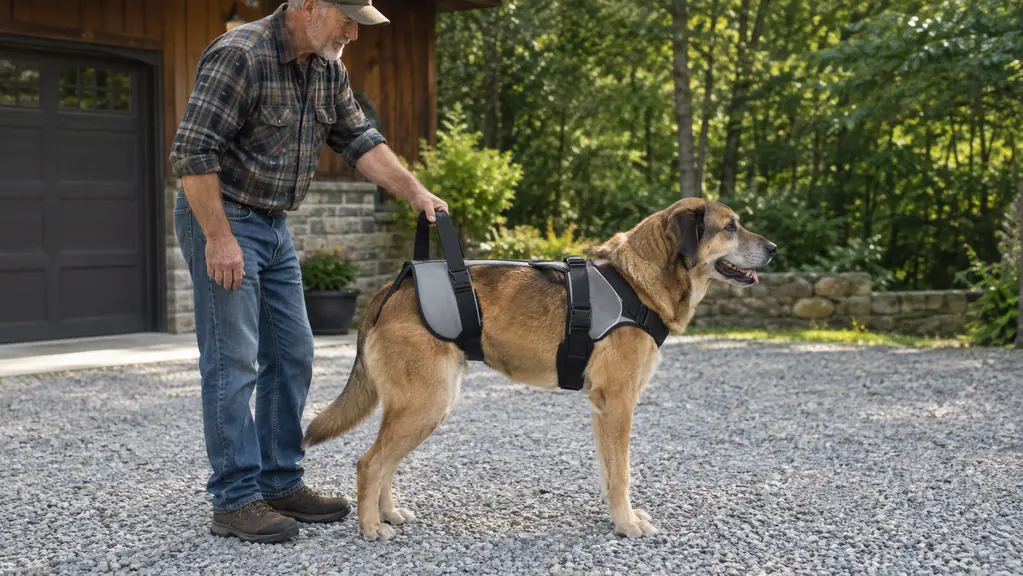
I have used the LOOBANI harness every morning for the past six weeks on our regular walk, and I keep it by the back door for the porch steps. The harness goes over his back with a strap around the chest and a wider strap around the belly, with two handles along the top, one behind his shoulders and one farther back. When he gets to the bottom of the porch steps, I lift the rear handle just enough that his back legs carry maybe half their usual weight. He walks up, I let go at the top, and he shakes himself like it was no big deal.
That is the honest version of what it looks like. It is not dramatic. There is no moment where Murphy suddenly dances. What there is, is a dog who no longer has to brace himself and lunge. He just walks up the steps, and that quiet normalcy is the whole point.
What the Listing Doesn't Tell You
The Amazon listing shows a happy dog trotting along with the harness on, and honestly, that photo is doing a lot of work. What the listing does not show you is that putting the harness on a dog the first few times is a two-person job unless your dog stands very still. Murphy is a good boy, but he is also 72 pounds of opinions, and the first time I tried to get the belly strap under him, he sat down and looked at me like I had lost my mind.
Here is what I learned. The buckles go on the sides, not the top, and you have to reach under the dog to grab them. That is awkward at first, and if your dog has a tender belly or a sensitive rear, you need to go slowly. I clip the chest strap first, then reach under for the belly strap, and I have learned to do it before he gets too excited. By day three, we had a routine. By week two, he would stand for it, tail wagging, because he knows the harness means a walk.
The other thing the listing does not tell you is that the handles are the whole point, and where you grab matters. The rear handle is the one that actually takes weight off his back legs. The front handle is more for steering and for giving him a little help over a curb. For the first week I was grabbing the wrong handle half the time, which meant I was pulling him up instead of lifting him, and neither of us liked it.
Another thing worth knowing: the harness changes how much I can help him in a way that is hard to describe until you try it. With just a collar, I have no way to take weight off his back end. With the rear handle, I can feel exactly how much he needs, and I can give him more on a stiff morning and less on a good one. That adjustability is the real value, and it is not obvious from the photos.
Getting the Fit Right
Fit is the difference between a harness that helps and a harness that rubs. LOOBANI includes a sizing chart based on chest girth, and I would tell you to measure your dog twice and order once. I measured Murphy at 34 inches around the chest, which put him at the top of the large range, and the straps still had room to spare. I tightened them until I could slide two fingers flat under the straps, no more. That is the test I use for any harness.
The padding matters more than I expected. The belly strap on this harness is wider and padded, which spreads the weight instead of digging in. On a dog with a heavy chest, a thin strap will roll and bunch, and you will see red marks after a walk. I have not seen that with Murphy, even on the mornings when he needs the most help.
One honest note: the straps can slip a little over the course of a walk, especially if your dog has a deep chest and a narrower waist like a Lab mix does. I check the fit when we stop at the corner, and I usually have to tighten the belly strap one notch before we head home. That is a small thing, but it is the kind of thing nobody puts in the review summary, and it matters if you plan to use the harness daily.
One more fit detail that took me a while to figure out: the harness has to sit in the right place to do its job. If the belly strap rides too far forward, the rear handle lifts his ribs instead of his hips, and he does not get the relief he needs. If it sits too far back, it can ride up toward his flank. I aim for the widest part of his belly, just behind the ribs, and I check that spot every time I clip him in. That positioning is the difference between a harness that works and a harness that just looks like one.
Where It Helps Murphy Most
The porch steps are the clearest win. Before the harness, Murphy would stop at the bottom, look up, and I could see him thinking about it. Now I clip him in, lift the rear handle, and he goes up without the pause. It has taken the anxiety out of the small moments, and I think that matters as much as the physical relief.
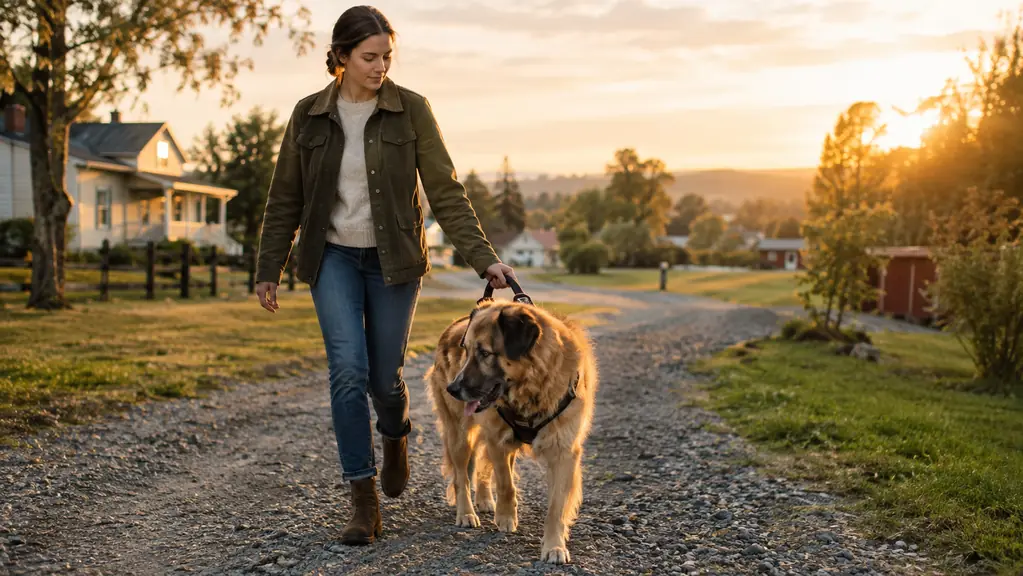
The second win is the morning walk. Murphy has always pulled ahead on a leash, but with his back legs weaker, he would drift to the side and sometimes stumble on uneven ground. With the rear handle in my left hand, I can steady him in the half second before a stumble turns into a fall. I have caught him twice that way, and I am convinced both times would have ended with him on the gravel.
The third win is the car. Murphy still jumps into the back seat, but he does not like it, and he hesitates at the door. I use the rear handle to take a little weight off, and he gets in with one hop instead of a lunge. My vet warned me that dogs with hip arthritis can injure themselves in that jump, so this feels like the most useful of the three.
What surprised me is how quickly he got used to it. Some dogs hate anything that goes over their back and will freeze in place the moment a harness comes out of the drawer. Murphy was not that bad, but he did need a few days of treats and patience. Now the sound of the buckles brings him to the back door, because he has learned that the harness means the good part of the day is about to start.
Where It Falls Short
Now for the part I would not have believed until I lived it. The harness is not a solution for a dog who cannot stand at all. It supports, it does not carry. If your dog's back legs have gone completely out, you need a sling that goes under the belly and lets you take most of the weight, and this harness is not that. The handles help you assist a dog who still has some strength. They will not hold the full weight of a 72-pound dog comfortably for any length of time.
It also does nothing for the front end. Murphy's arthritis is in his hips, so the rear support is exactly what he needs. If your dog has weakness in the front legs, or a condition that affects all four, this is the wrong tool, and I would rather you hear it from me than figure it out after you have already bought it.
The last limit is the simplest: it is a tool, not a treatment. The harness does not reduce inflammation, it does not replace the joint supplement our vet recommended, and it does not change the fact that one day Murphy will need more help than this. On the days he is stiff, the harness makes the morning easier, and then I still give him his supplement and I still call the vet when something changes. If you are hoping the harness will fix the underlying problem, it will not, and you should know that before you click buy.
I looked at other options before I settled on the LOOBANI. A simple rear sling is less expensive and faster to put on, but it gives you less control on a walk and it can bunch up around the belly. A full-body harness with handles at both ends gives more control, but it takes longer to clip on and it felt like more harness than Murphy needs. And there was the option of doing nothing, which is the choice I made for longer than I should have, because I kept telling myself he was fine. What won me over was the balance of support and simplicity. It has enough padding that Murphy does not fight it, enough adjustment that I can change the fit as he changes, and enough handle that I actually use it.
What I Liked
- Padded belly strap spreads the weight without digging in, even on a 72-pound dog
- Two handles give real control: the rear handle lifts, the front handle steers
- Secure side buckles stay put through a full morning walk
- Adjustable enough to change the fit as your dog's needs change
- Survived six weeks of daily use with no fraying or loose stitching
Where It Falls Short
- Putting it on takes practice, and the first few tries are a two-person job
- Straps can slip slightly on deep-chested dogs and need a mid-walk check
- It supports, it does not carry, so it is not for dogs who cannot stand
- Does nothing for front leg weakness, so it is not a fix for every mobility problem
The harness did not fix Murphy's hips, and I never expected it to. What it did was take the pause out of the porch steps, and for a 10-year-old dog, that pause was the thing I dreaded most.
Who This Is For
Buy the LOOBANI lift harness if your dog still has strength in his back legs but needs help with the moments that have gotten harder: steps, curbs, getting up after a nap, getting into the car. It is for dogs in the early and middle stages of rear leg weakness, when the goal is to keep them moving and take the edge off. It is also for owners who do not want to bend down and lift, because the handles put the leverage in your hands instead of your lower back. The harness is handy on days after a long walk too, when Murphy is tired and the evening trip outside feels harder than the morning one, so I keep it near the back door all week, not just for walks. I would also say it is for dogs whose owners are willing to watch and adjust. The harness does not set and forget. You check the straps, you watch how your dog moves, and you change the fit as the season changes. That attentiveness is what makes the difference, and it is the part of the job that no product can do for you. I am 57, I go to the gym three days a week, and I still appreciated not having to squat and heave every time Murphy needed a hand.
Who Should Skip It
Skip it if your dog cannot bear weight at all, because this harness is an assist, not a wheelchair. Skip it if the weakness is in the front legs, because the harness does nothing for the front end. And skip it if you are hoping for a fix for the underlying problem, because the harness is one small part of a care plan that includes your vet, your dog's diet, and his joint supplement. There is nothing wrong with wanting the tool that matches the job, and for a dog who can still walk, this one matches the job. And one more group: if you are the kind of owner who will not take the time to get the fit right, or who expects the harness to work without any practice, this is probably not for you. It is a tool you have to learn, and the learning is part of the job.
The Takeaway: It Helped Where It Counted
Six weeks in, the LOOBANI harness is still hanging by the back door, which is the highest compliment I can give any piece of dog gear. If your dog hesitates at the steps the way Murphy did, it is worth a look. Check today's price on Amazon, and measure your dog's chest before you order.
Amazon Check Today's Price on Amazon →